

LinkedIn Ads
- LinkedIn Ads Revenue Attribution
- LinkedIn Ads Customer Journeys
- LinkedIn Ads CRM Sync
- LinkedIn Ads Optimization
- LinkedIn Ads Benchmarks

Google Ads

Meta Ads
Cross-Channel
Ad Signals
New



How to Analyze LinkedIn Ads with ChatGPT Using Fibbler's MCP Server
Quick Summary
Campaign Manager shows clicks. Your CRM shows pipeline. Neither shows you the connection between the two. Fibbler's MCP server bridges that gap, and with ChatGPT connected to it, your LinkedIn Ads data becomes something you can interrogate rather than just report on.
Your LinkedIn Ads, Finally Understood
You've probably already asked ChatGPT about your LinkedIn Ads. And you got back a confident, well-structured answer about CTR benchmarks, audience targeting, and campaign optimisation best practices. None of it was about your actual campaigns.
Without a live connection to your data, ChatGPT is working from general knowledge about how LinkedIn Ads work. Not from what you're spending, who's engaging, or which campaigns are influencing deals in your pipeline. Useful for conceptual questions, useless for the ones that actually drive budget decisions.
Fibbler's MCP server fixes that. Connect it to ChatGPT and your LinkedIn Ads and CRM data become queryable in plain language, grounded in real attribution rather than educated guesses. This guide walks through the setup and what to ask once you're in.
Why Listen to Us?
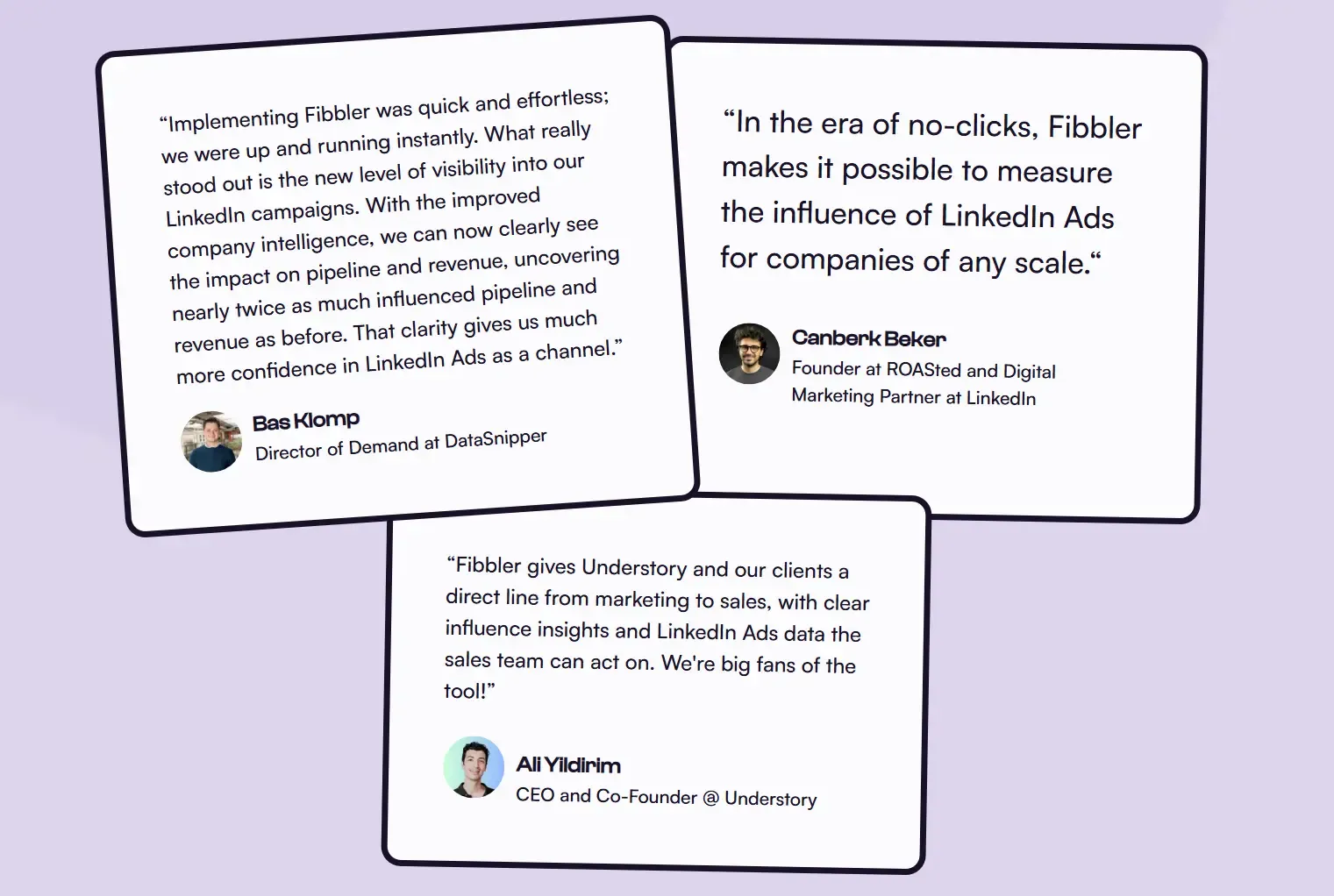
We've been working on the LinkedIn-to-CRM attribution problem since before MCP existed, and over 2,000 B2B marketers now run their LinkedIn reporting through Fibbler. Teams at ROASted, Understory, Juro, and Copper CRM use us to show campaign-level revenue influence, and we hold a 4.9/5 rating across more than 50 G2 reviews.
As an official LinkedIn Marketing Partner, we draw on LinkedIn's Company Intelligence API, which surfaces around 10x more company-level engagement data than tools relying on older API access. When ChatGPT queries Fibbler through MCP, that's the dataset it's reasoning across.
Why Analyze LinkedIn Ads with ChatGPT
LinkedIn campaigns produce far more data than any one dashboard can summarize well. Frequency curves, account-level engagement tiers, multi-touch sequences, impression trends. All of it matters and none of it fits neatly into a single view.
ChatGPT shines here because you can keep asking until you've actually understood something. A few common workflows:
- Convert raw spend into a revenue narrative. Have ChatGPT pull active-pipeline campaigns alongside high-spend dead ends and explain the gap in plain English.
- Diagnose creative fatigue before it shows in CTR. Ask whether engagement on specific campaigns is decaying and roughly when the slide started.
- Build a defensible CPC argument. Get ChatGPT to test whether high-engagement accounts close at bigger deal sizes, then use the answer to justify premium bids to leadership.
- Surface ABM accounts hiding in plain sight. Pull a list of companies racking up impressions but no clicks, then have ChatGPT prioritize them by trend.
- Pressure-test cross-channel theories. Walk through closed-won journeys and ask ChatGPT where LinkedIn typically appears relative to other touchpoints.
- Draft quarterly budget reallocations. Get a structured recommendation grounded in pipeline influence rather than CTR or CPC, then push back on the reasoning before you commit.
What You'll Need Before You Start
A few prerequisites before you can connect ChatGPT to your Fibbler data:
- Fibbler on the Unlimited or Agency plan. MCP is included on these plans only. See pricing for the breakdown.
- LinkedIn Ads connected to Fibbler. This is what gives ChatGPT something real to query, instead of working from general knowledge.
- A CRM connected to Fibbler. HubSpot, Salesforce, Attio, or Pipedrive. Pipeline questions need both halves of the join.
- ChatGPT on a paid plan with connector support. MCP connections aren't available on the free plan.
If you're not on Fibbler yet, you can spin up a free trial at fibbler.co.
Connecting Fibbler's MCP Server to ChatGPT
ChatGPT connects to Fibbler via OAuth, so there's no API key to manage. The setup runs in about a minute.
Step 1: Open a new ChatGPT conversation
In the ChatGPT app or web interface, start a new chat.
Step 2: Add Fibbler as an MCP server
Click the connectors icon (the plug icon) in the message input, then select Add MCP Server. Paste in the server URL:
https://app.fibbler.co/mcp
Step 3: Authorize with your Fibbler account
ChatGPT will redirect you to Fibbler to log in and approve access. Once approved, Fibbler will appear in your list of connected tools.
Step 4: Verify the connection
Open a new chat and ask: "Give me an overview of my Fibbler account."
ChatGPT will call the get_account_overview tool and return a summary of your connected integrations and the data it can now reach. If that summary appears, the setup is complete.
If you hit an authentication error, try disconnecting and reconnecting. Fibbler's MCP common issues guide covers most failure modes.
The LinkedIn Ads Prompt Library for ChatGPT
ChatGPT works best when you treat it like a conversation rather than a report generator. The prompts below are starting points. Each one opens a line of inquiry you can push further with follow-up questions. Start broad, see what comes back, then get specific.
Each prompt is copy-paste ready. Adjust date ranges, deal stages, and engagement thresholds for your context.
The Spend-to-Revenue Map
"Using Fibbler data, give me two lists for the last 90 days. List one: LinkedIn campaigns ranked by influenced pipeline value, with spend and influenced deal count next to each. List two: LinkedIn campaigns ranked by spend, with influenced pipeline value next to each. Highlight any campaign that appears near the top of list two but not list one."
What this reveals:
The two-list structure makes the spend-versus-impact gap impossible to miss. Campaigns near the top of list two but absent from list one are your most expensive non-performers. Campaigns climbing list one despite modest spend are your scaling candidates.
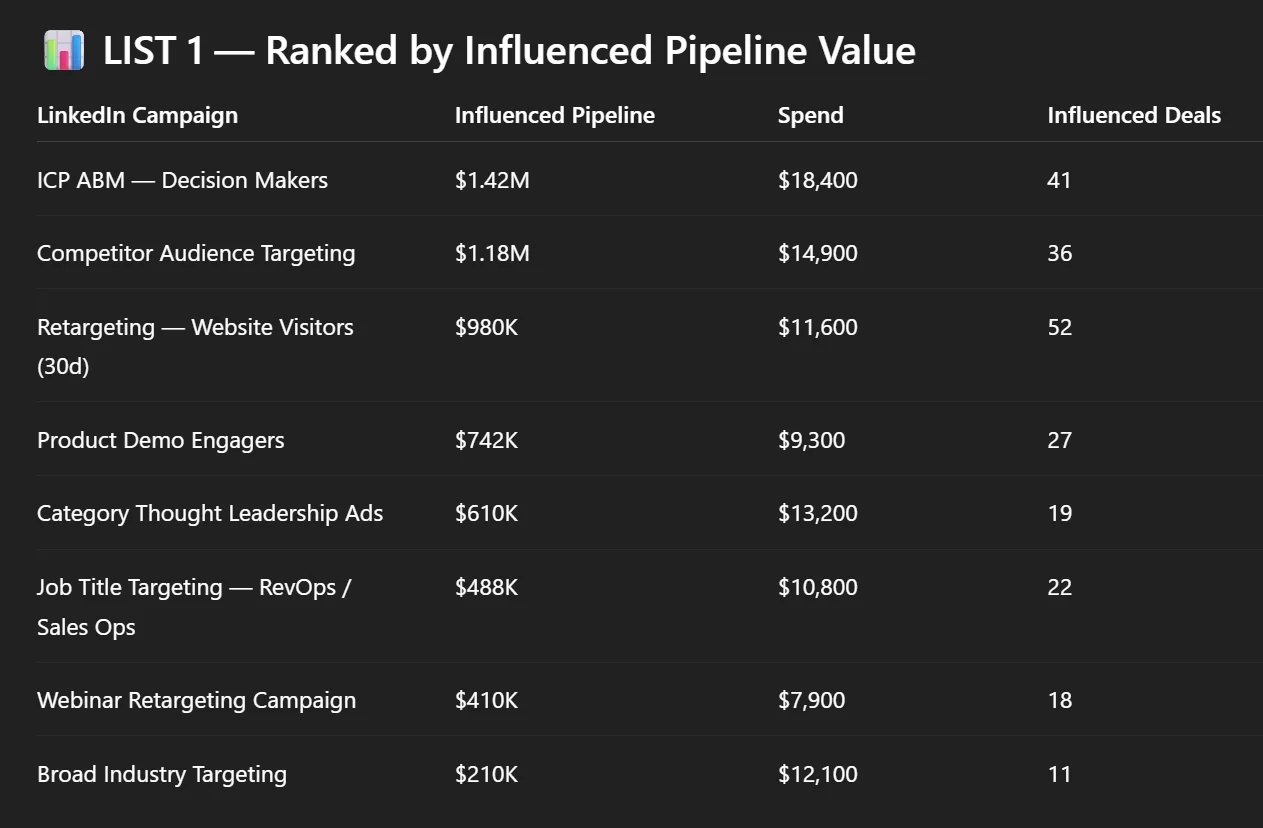
The natural follow-up is the question that turns this into a real decision: "For the campaigns near the top of list two but not list one, are they reaching companies whose engagement is climbing?"
If yes, you're in awareness mode and patience is the right move. If not, you have a pause-or-rework decision waiting.
The Engagement-Tier Revenue Test
"Pull closed-won deals from the last 12 months where LinkedIn Ads were part of the journey. Group those deals by Fibbler's engagement tier (low, medium, high) and show me average deal size, win rate, and average sales cycle for each tier. Then tell me whether the difference between tiers is meaningful."
What this reveals:
Fibbler classifies engaged companies into low, medium, and high tiers based on the depth and frequency of their interactions with your ads. This prompt asks whether that classification actually predicts revenue outcomes the way it should.
If the high tier closes notably bigger or faster than the low tier, you have a strong argument for spending more on frequency, retargeting, and sequenced creative to push target accounts up the tiers. If the tiers look similar, your engagement signal is mostly noise and you have a creative or targeting problem to solve before you scale.
Push it further with: "Which campaigns are responsible for the most high-tier engagement?"
The Frequency Sweet Spot
"For companies that became closed-won customers in the last 12 months, look at the total number of LinkedIn ad impressions Fibbler recorded against them before they entered pipeline. Bucket the deals by impression count (1-5, 6-15, 16-30, 31+) and show me win rate and average deal size for each bucket."
What this reveals:
Frequency capping is one of LinkedIn's most underused levers, mostly because nobody knows where the diminishing-returns curve actually bends. This prompt finds the curve in your data.
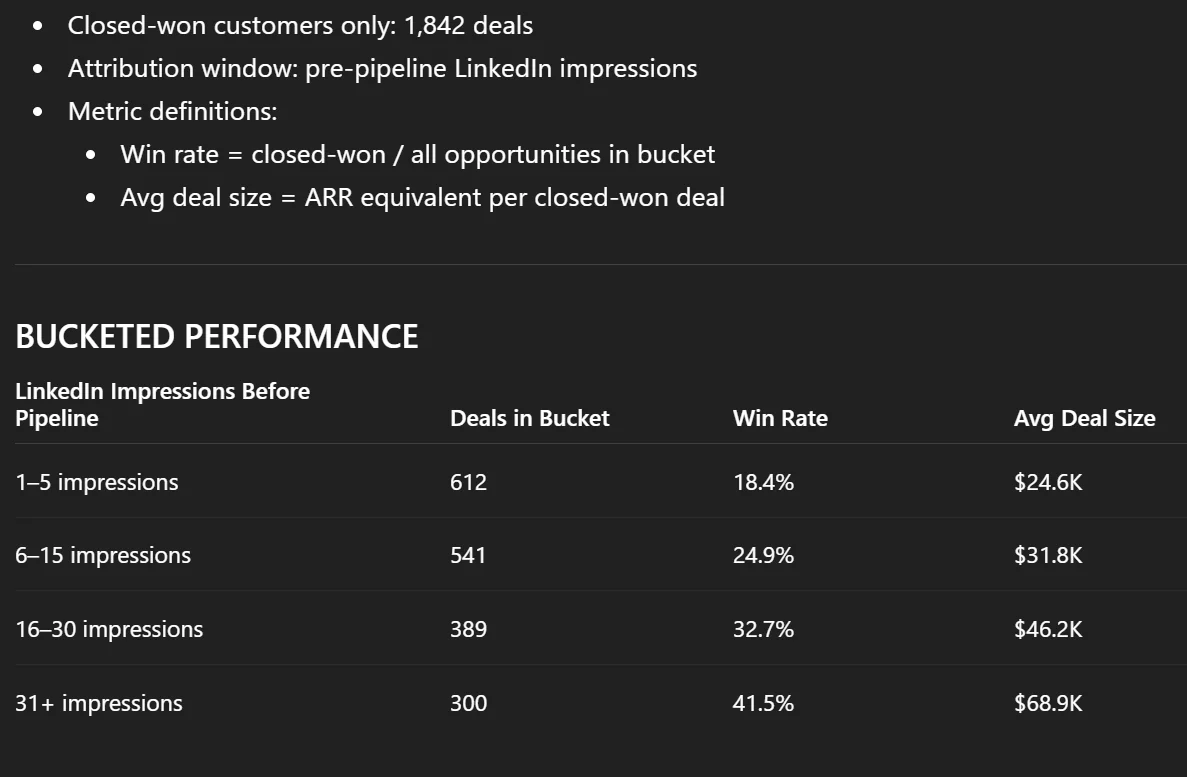
If win rates plateau after fifteen impressions, you're likely overspending on companies past that threshold and underspending on accounts that haven't hit it yet. The output is the data backbone for setting impression caps that match how your buyers actually behave, rather than guessing based on industry benchmarks.
The Silent Account Watchlist
"Find companies in Fibbler's data that have received at least 10 LinkedIn ad impressions in the last 60 days, and have not clicked, visited our website, or entered our CRM. Show me their impression trend over the period, sorted by total impressions."
What this reveals:
These are the accounts in your dark funnel: visible to your campaigns, invisible to your sales team. The trend matters more than the raw list. An account whose impressions are rising week-over-week is materially different from one that saw three ads early in the period and disappeared.
Pass the rising-trend list to SDRs the same day. Fibbler's Signals feature can route this automatically into Clay, Slack, or your outbound stack the moment a company qualifies.
The Lift Sanity Check
"Pull the most recent Fibbler Lift Analysis. Walk me through what the close rate lift, deal size lift, and sales cycle comparison are saying. Where do the numbers most strongly support continued LinkedIn investment, and where do they look weakest? Be specific about the magnitude of each lift."
What this reveals:
Lift Analysis compares LinkedIn-influenced deals against a non-influenced baseline of similar deals, which is the rigorous version of the "is LinkedIn working?" question. ChatGPT can read the raw numbers and turn them into an interpretation you can act on.
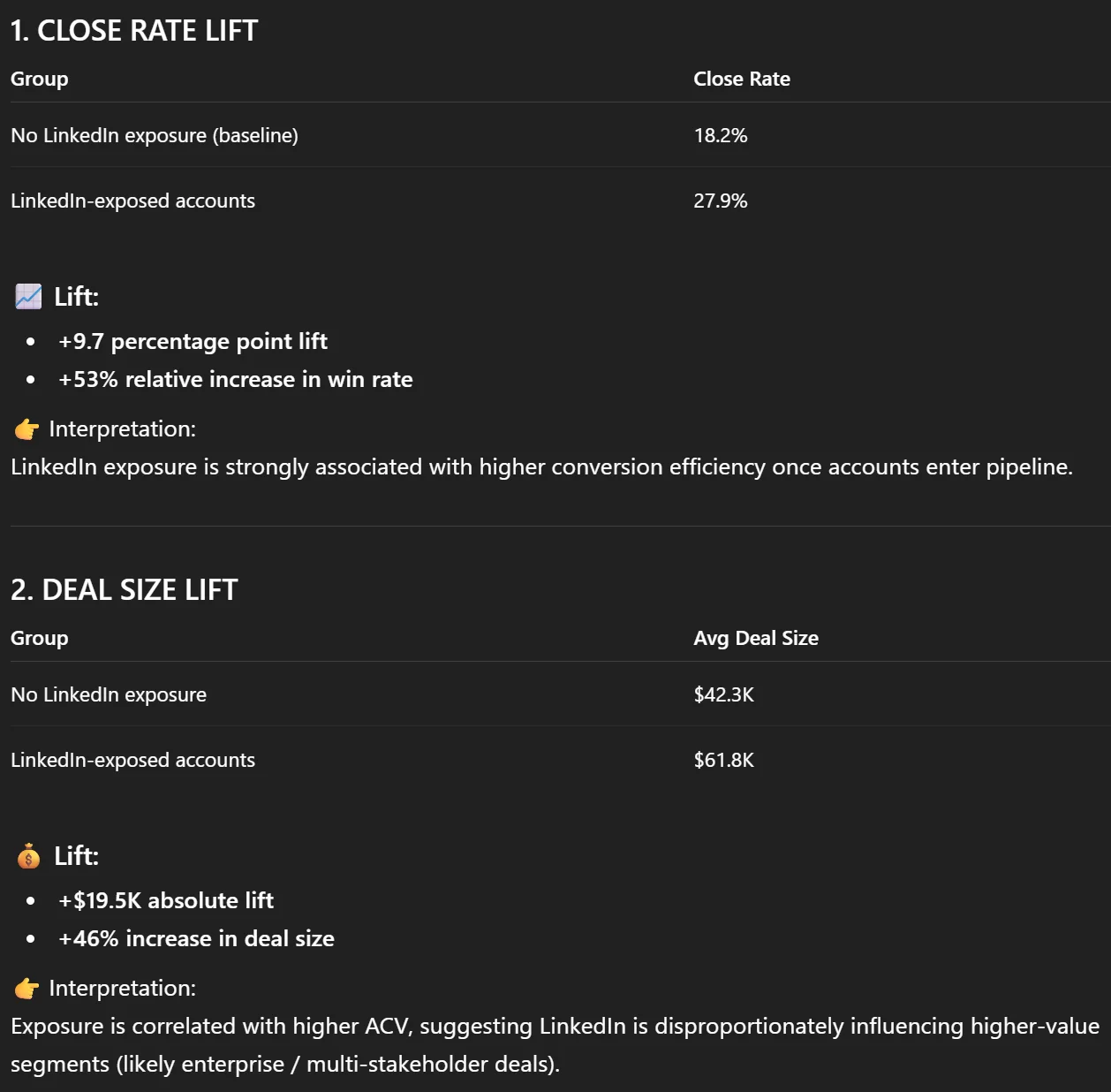
If close rates are notably higher on influenced deals but cycle length is similar, LinkedIn is doing demand capture work. If cycles are shorter but close rates are flat, it's accelerating deals you would have won anyway. The interpretation drives different next moves, and ChatGPT is good at making those distinctions explicit.
The Multi-Channel Budget Defense
"Using Fibbler's channel overlap data, compare deals closed in the last six months that were influenced by LinkedIn only, Google Ads only, and both channels. Show me deal count, average pipeline value, average sales cycle, and win rate for each segment. Then explain what the comparison suggests about how the two channels work together."
What this reveals:
Multi-channel-influenced deals usually close at higher values than single-channel deals. If your data confirms that pattern, you have a hard answer for the next budget meeting where someone suggests cutting one channel to fund the other. ChatGPT's synthesis makes the case clean: here's the segment, here's the average outcome, here's what it means for next quarter's mix.
Push it further with: "Where in the journey does LinkedIn typically appear in the deals influenced by both channels, early or late?"
The Quarterly Reallocation Brief
"Based on Fibbler data from the last quarter, build a budget reallocation recommendation for next quarter assuming flat total LinkedIn spend. Use cost per company engaged, influenced pipeline by campaign, and average deal size of influenced opportunities. Specify which campaigns to scale, which to cut, and which to rework, with the supporting numbers for each call. Then walk me through the reasoning behind your top reallocation."
What this reveals:
This is where analysis turns into strategy. The "walk me through the reasoning" instruction matters as much as the request itself. Asking ChatGPT to explain the logic lets you pressure-test the recommendation before taking it into a planning conversation.
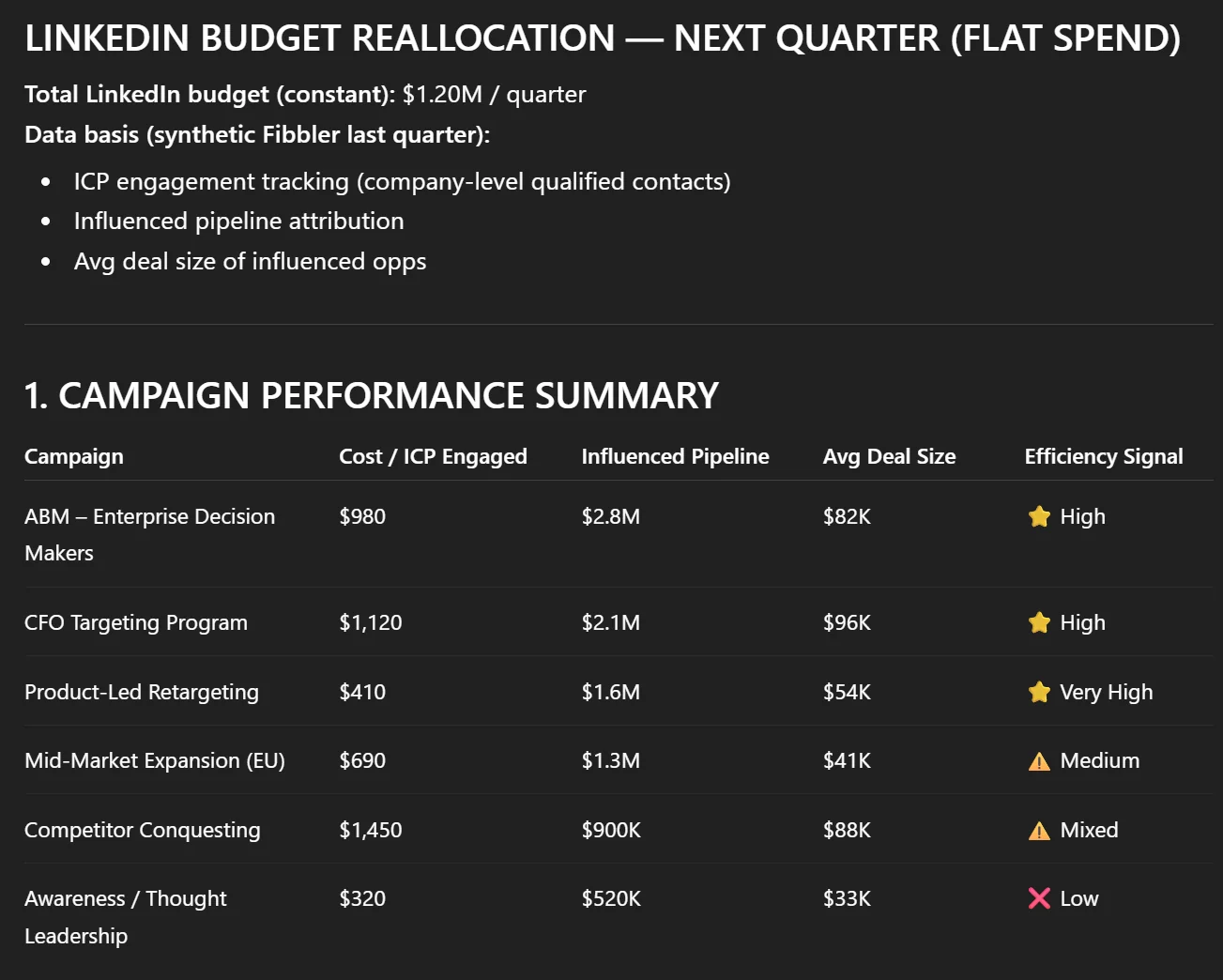
The output isn't a final answer. It's a well-reasoned draft, structured enough to drop into a leadership doc with light editing, and grounded enough that you can defend the numbers when the questions land.
Interpreting What ChatGPT Tells You
Getting answers back is only half the job. Here's how to turn them into decisions.
When ChatGPT identifies a high-spend, zero-pipeline campaign
Don't pause it on first sight. Run the follow-up first: ask whether companies in that audience are still engaging and whether their impression frequency is rising. The answer changes everything. A flat trend with low-engagement companies justifies a pause. A rising trend with high-engagement accounts justifies patience.
When ChatGPT shows weak engagement-to-revenue correlation
If your high-engagement tier doesn't close bigger or faster than the low tier, the issue isn't usually the channel. It's the targeting or creative. Ask: "Which campaigns produce most of the high-engagement companies that never enter pipeline?" That narrows the diagnosis to specific campaigns instead of forcing a wholesale rethink.
When ChatGPT surfaces silent ABM accounts
Pass them to SDRs with context, not as a raw list. Include the campaigns they've engaged with most and the impression trend. Outreach that references a relevant theme (without revealing how you know) outperforms generic sequences by a wide margin, and Fibbler is what makes that personalisation possible at scale.
When ChatGPT produces a budget recommendation
Run the reasoning follow-up before presenting it anywhere. The recommendation is a starting point backed by your data. The reasoning is what makes it defensible in a room.
What This Workflow Replaces
Before connecting ChatGPT to Fibbler's MCP server, answering any of the questions above meant exporting from Campaign Manager, exporting from your CRM, joining the two in a spreadsheet, and presenting numbers that were already days old by the time anyone read them.
That process burned hours. It was bounded by the questions you thought to ask in advance. And it produced static outputs you couldn't interrogate further.
The MCP workflow replaces all of it with a conversation. You ask, ChatGPT queries your live Fibbler data, and you follow the thread wherever it leads - pushing on follow-ups, drilling into anomalies, surfacing insights a static report would never produce because nobody thought to look for them.
What used to take a morning takes minutes. More importantly, the analysis doesn't stop at the first answer.
Getting Started
MCP is included on the Unlimited and Agency plans. If you're not yet using Fibbler, the free trial is the right starting point. Most teams see their first attribution data within 30 minutes of connecting LinkedIn Ads and a CRM. Once Fibbler is live, adding it to ChatGPT takes about a minute, and the prompts above are ready immediately.
No credit card required. Cancel any time.
Written by

Adam Holmgren
CEO @ Fibbler

Prove paid ads drive pipeline
Fibbler helps you see which companies view or engage with your LinkedIn Ads and Google Ads and connect them to pipeline and revenue in your CRM.
Try 30 days for free
Prove paid ads drive pipeline
Fibbler helps you see which companies view or engage with your LinkedIn Ads and Google Ads and connect them to pipeline and revenue in your CRM.
Try 30 days for free