

LinkedIn Ads
- LinkedIn Ads Revenue Attribution
- LinkedIn Ads Customer Journeys
- LinkedIn Ads CRM Sync
- LinkedIn Ads Optimization
- LinkedIn Ads Benchmarks
Google Ads

Meta Ads
Cross-Channel
Ad Signals
New



LinkedIn Ads vs Google Ads for B2B: What Actually Drives Pipeline in 2026
Quick Summary
B2B teams often treat LinkedIn Ads and Google Ads as rivals - a mistake that could fragment pipeline strategy. Google captures existing demand while LinkedIn builds awareness, making multi-channel attribution the real challenge for measuring enterprise revenue.
The Flawed Debate Destroying B2B Budgets
Marketing leaders often spend significant time debating whether to allocate budget to search or social, frequently pitting these two platforms against each other in board meetings. Executives look at isolated dashboard metrics and try to declare a winner instead of understanding how the channels interact.
Failing to recognize this synergy leads to a form of binary thinking that can damage pipeline generation. This perspective treats the platforms as interchangeable, erroneously comparing a channel optimized to manufacture awareness with one built to intercept active shoppers.
While both ultimately aim to drive revenue, they specialize in different stages of the buyer journey. As a result, measuring them against the same narrow KPIs often results in pulling funding from the very campaigns that build future demand.
Why Listen to Us?
We built Fibbler after watching incredible B2B marketing teams struggle to show their multi-channel impact to executive boards. Teams spend months educating high-value accounts on LinkedIn, only to watch their CRM award all the pipeline credit to Google when those buyers finally search for the company to request a demo.
Validation from the front lines: Here is how B2B leaders describe our impact:
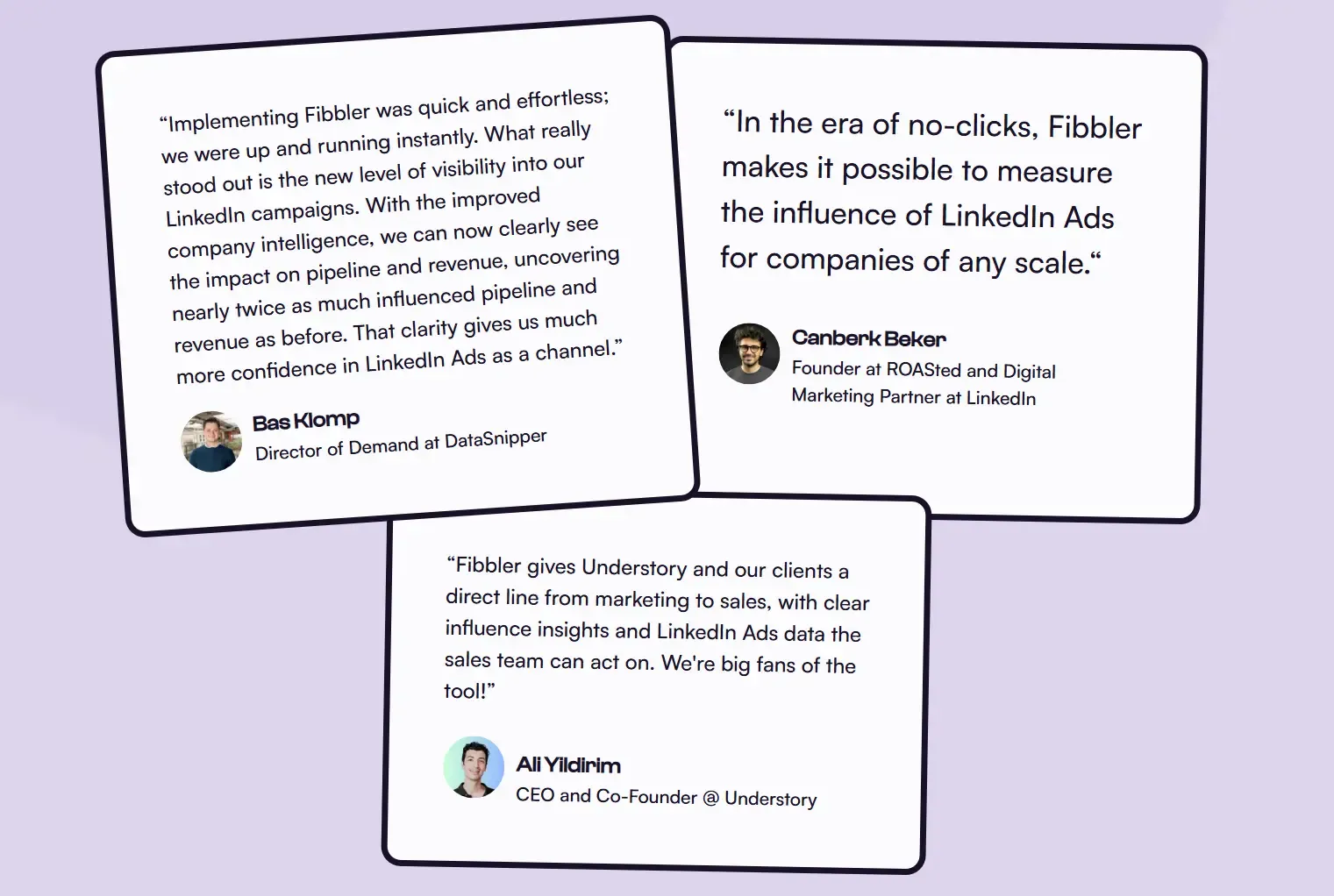
As an Official LinkedIn Marketing Partner trusted by over 2,000 performance marketers, our platform focuses on connecting that hidden social engagement to highly visible search conversions.
Why Most B2B Teams Misjudge the Data
When finance teams audit marketing spend, they usually demand hard efficiency metrics like cost-per-click and immediate conversion rates to judge a channel's worth. Under this rigid financial lens, Search appears significantly cheaper and far more effective because it intercepts users at the exact moment they want to buy.
Relying on immediate click data leaves marketing leaders vulnerable to three specific blind spots that distort their understanding of the pipeline:
The Last-Click Illusion
Standard marketing analytics tools heavily favor the final action a user takes before filling out a form, which naturally biases reporting toward search engines. A prospect types a brand name into Google, clicks the top ad, and requests a demo, prompting the dashboard to award complete pipeline credit to that specific search campaign.
This tracking flaw makes the previous three months of passive social education disappear from the record entirely. It creates a dangerous illusion that search is single-handedly driving the entire business while social channels burn budget.
The Myth of the Straight-Line Journey
Enterprise buyers do not wake up, search for a random software category, and immediately sign a massive contract on the same day. These deals involve complex buying committees, hidden Slack conversations, and months of internal debate before anyone ever fills out a website form.
A prospect might see a piece of content on a Tuesday, ignore it, and revisit the website a month later after bouncing across multiple devices and browsers. Expecting a straight line from an initial ad click to a closed-won deal is simply unrealistic, meaning the measurement model must reflect the often messy reality of human behavior.
The Multi-Stakeholder Blind Spot
Search data typically tracks the single individual who eventually fills out the form, ignoring the five or six other executives who influenced the decision. While one junior manager might click the final search ad, the VP and CFO often spend weeks consuming educational content on social media without ever clicking a trackable link.
Understanding the Core Difference: Capture vs. Awareness
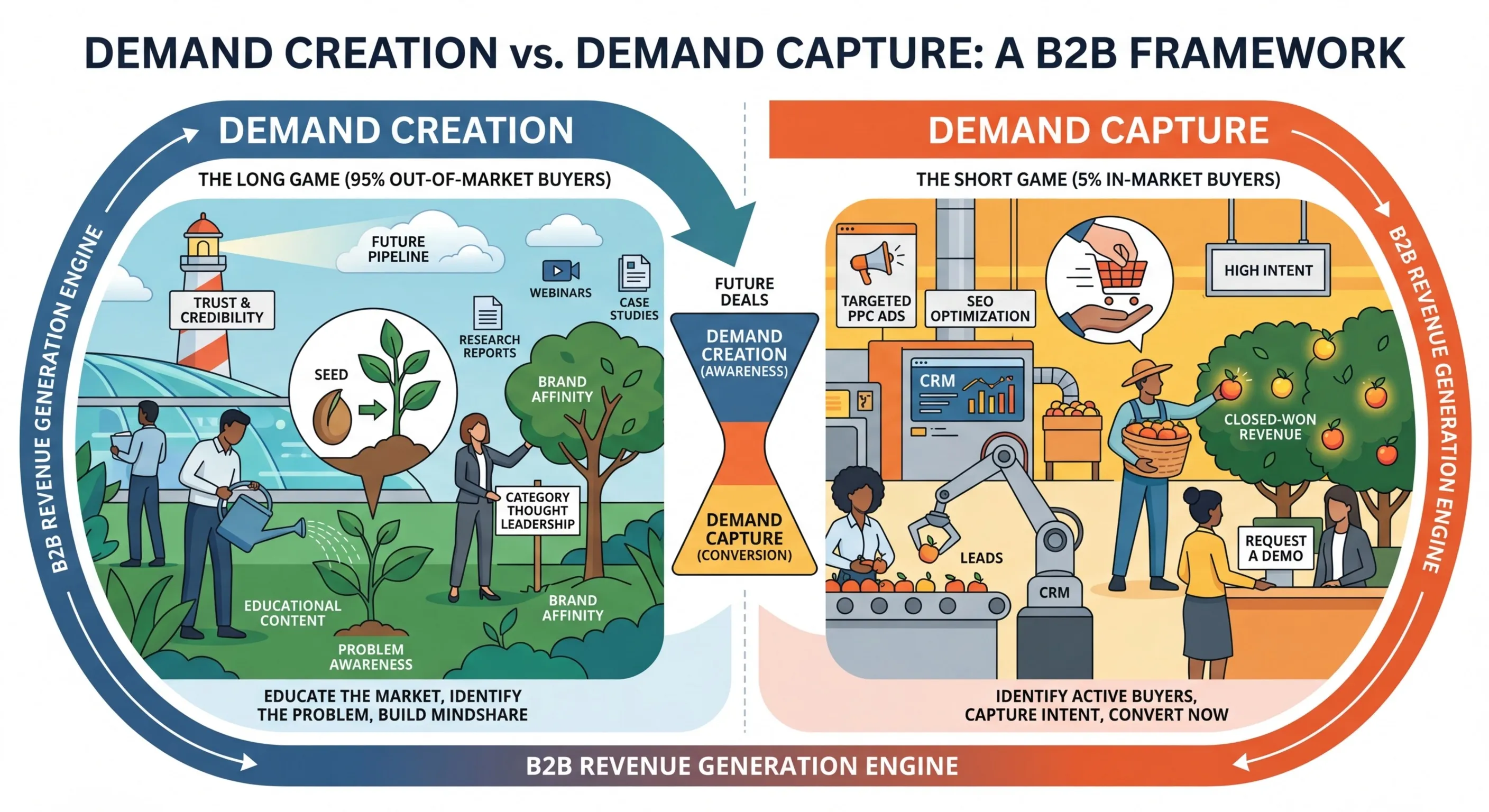
As a B2B marketer, evaluating success across both LinkedIn Ads and Google Ads requires a fundamental shift in perspective. Judging a LinkedIn campaign by the same immediate conversion standards as a Google campaign often undervalues the long-term contribution to the pipeline, as it fails to account for how these two channels operate on different timelines.
Adopting a more accurate measurement strategy requires recognizing that they serve distinct psychological needs within the buyer journey.
Google Captures Existing Demand
In the mindset of a person typing a query into a search bar, there is typically a recognized pain point and a search for a specific solution. This high-intent state makes Google Ads effective for bottom-of-funnel conversion because the search results meet the buyer during their active evaluation of pricing or features.
Rather than needing to convince a prospect that they have a problem, the primary goal of a Google Search campaign is to demonstrate that a specific product provides the most effective resolution for an issue the buyer is already attempting to solve.
LinkedIn Builds Awareness
Professionals do not typically scroll through social feeds with the intent of purchasing enterprise software; they log in to network, stay informed, or consume thought leadership. In this environment, the role of LinkedIn Ads is to introduce a new concept and slowly shape the buying committee's internal strategy.
By using LinkedIn's professional targeting, a brand can establish trust early in a decision-maker's conceptual process. This ensures that when that buyer eventually turns to a search engine to find a solution, the brand has already established itself as the trusted authority - long before the first search query is ever entered.
The Timing Gap Between Channels
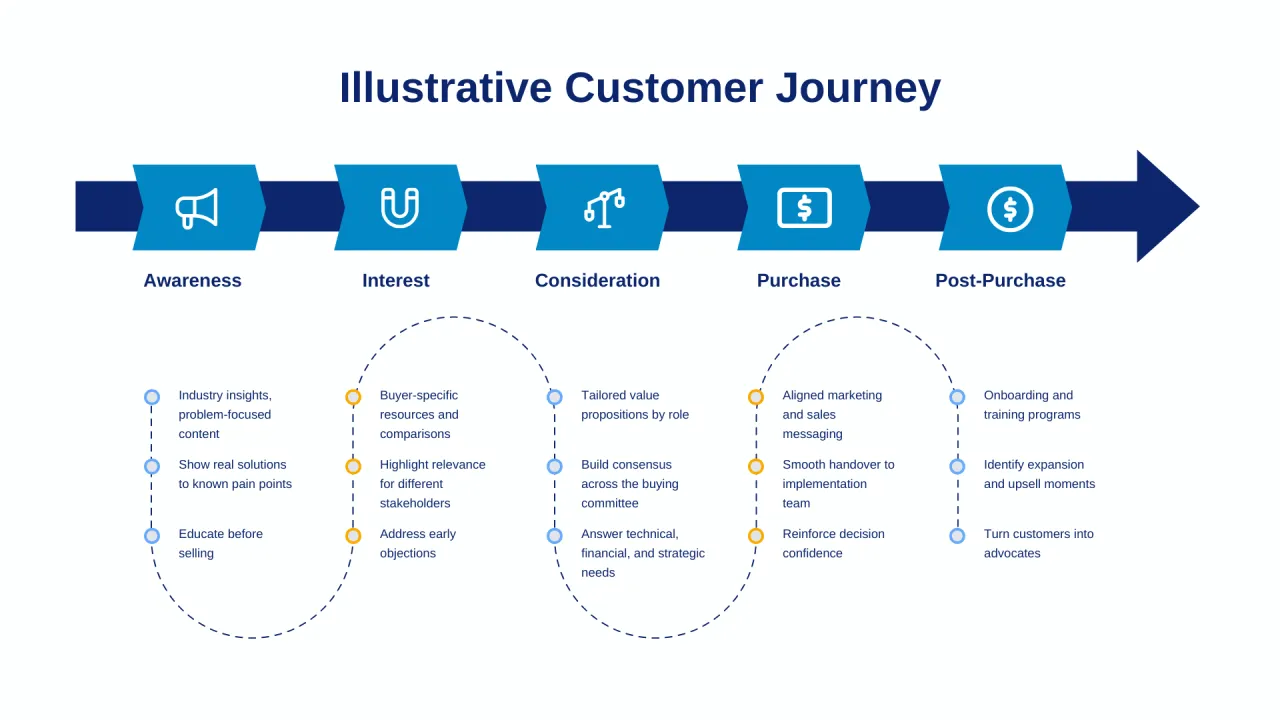
The difference in user psychology between these platforms can often create a timing gap in reporting, which potentially causes teams to prematurely shift budget away from their most effective campaigns.
Google Search campaigns frequently provide more immediate feedback, allowing an organization to invest budget today and see a prospective buyer request a demo shortly after. In contrast, LinkedIn Ads represent a much longer journey - a 7-month marketing marathon according to Dreamdata's 2026 LinkedIn Benchmarks Report.
The report indicates that B2B journeys have stretched to 272 days, with buyers spending the first seven months (220 days)in a "silent" education phase. During this window, 81% of the customer journey happens outside the sales pipeline, meaning the primary goal of LinkedIn is to win the deal before a sales representative even knows it exists.
Without the proper tracking infrastructure to account for this potential 272-day delay, a company risks dismantling the very engine that may be quietly generating its future demand - simply because the results are not yet visible on a weekly dashboard.
Targeting Capabilities: Intent vs. Identity
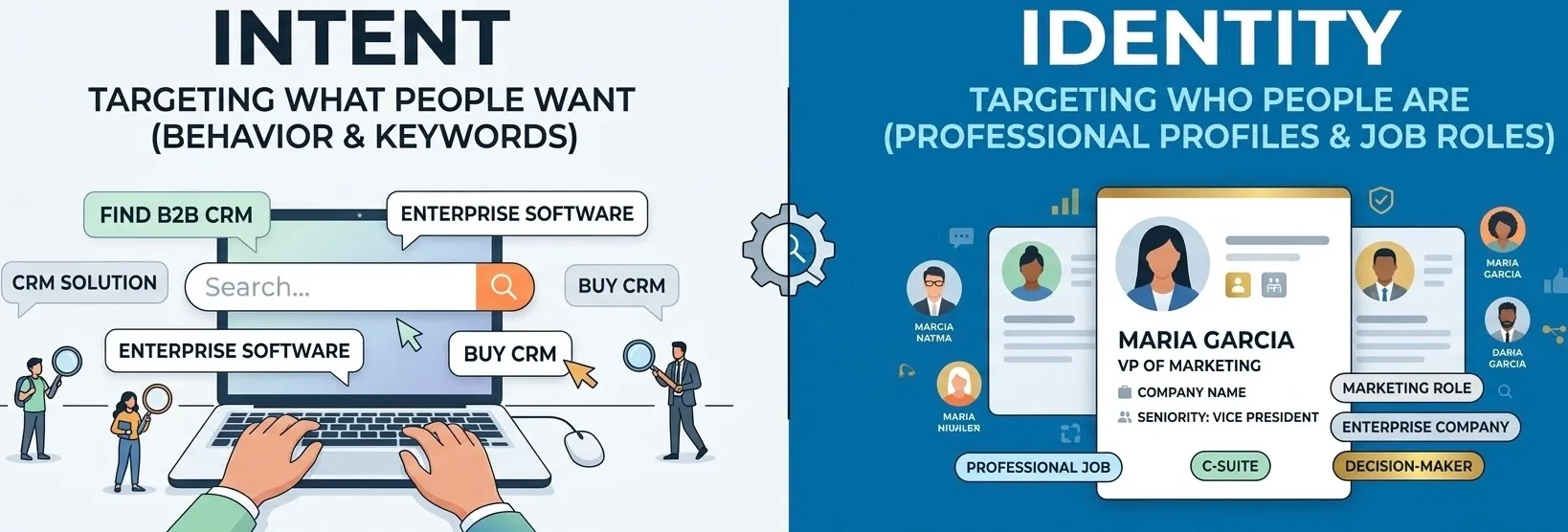
The mechanical differences between Google Ads and LinkedIn Ads perfectly mirror their strategic purposes, completely changing how marketers build audiences. The former targets what people want right now, while the latter targets exactly people who are in the professional world.
The Power and Limits of Keyword Intent in Google Ads
Search targeting through Google Ads relies primarily on behavioral intent, allowing an organization to bid on specific phrases that indicate a prospective buyer is actively researching a category. This intent-based model can significantly increase the likelihood of reaching an audience ready to convert, though it can sometimes lack demographic precision.
When targeting keywords like "enterprise CRM," advertisers cannot fully control who clicks. Campaigns may attract a Fortune 500 CIO ready to buy or a student conducting research, unless targeting is refined with negative keywords and tighter intent filters.
Without identity-based data, a portion of the budget can inadvertently go toward clicks from anonymous users who do not fit the Ideal Customer Profile (ICP), simply because they used the right search terms.
The Precision of Professional Identity in LinkedIn Ads
Targeting within LinkedIn Ads prioritizes verified professional identity over search behavior. This precision is vital as Dreamdata's 2026 report shows the average buying committee has expanded to 10 stakeholders. By targeting job titles and seniority levels, brands ensure they reach every member of that 10-person group.
This approach guarantees that advertising spend is directed toward educating the ICP, regardless of whether they have immediate buying intent. By reaching the right professional "room," a brand can establish authority with decision-makers long before they ever enter a formal search process.
Cost and Efficiency: LinkedIn Ads vs. Google Ads (2026 Benchmarks)
Comparing LinkedIn Ads and Google Ads based purely on cost-per-click (CPC) frequently creates a distorted view of actual campaign value.
While a LinkedIn Ads campaign might initially show a higher CPC, Dreamdata's 2026 benchmarks reveal a more complex financial reality: when shifting focus toward Ideal Customer Profile (ICP) engagement, LinkedIn often proves more efficient than search.
When organizations prioritize reaching a verified decision-maker over a generic visitor, the comparative efficiency of these platforms often changes:
- Budget Allocation: As search volume for high-intent keywords remains finite, LinkedIn now commands 41% of B2B advertising budgets, according to Dreamdata.
- Cost Per ICP Engagement: Reaching a verified, qualified target account can cost roughly $257 on LinkedIn, compared to $560 on Google when factoring in the cost of unqualified or anonymous search clicks.
- Impact on Deal Size: Educating the entire buying committee early removes massive friction during procurement, leading to LinkedIn-sourced deals landing 28.6% larger on average.
- Full-Funnel ROAS: According to Dreamdata, when measured across the entire multi-touch journey, LinkedIn drives a massive 121% ROAS, comfortably outperforming Google's 67% return.
This account-level efficiency is further proven by the Cost per Company Influenced, which Dreamdata now clocks at €70.11 on LinkedIn - nearly 40% cheaper than the €110.37 average for Google Search. By focusing on the cost to influence the entire account rather than just a single click, the long-term value of social-led brand awareness becomes clear.
The Attribution Gap: Why Traditional Tracking Fails B2B Revenue Teams
While Dreamdata's 2026 benchmarks indicate that LinkedIn Ads drive larger deals and better returns, many organizations still struggle to justify the spend because their technical infrastructure is often ill-equipped for complex buyer journeys.
Most B2B organizations attempt to track nuanced human behavior using CRM technology originally designed for simpler, single-click transactions.
This reliance on outdated tracking models creates two specific structural obstacles that prevent revenue leaders from seeing the full impact of their brand awareness efforts:
The Last-Touch Bias in Traditional CRMs
Most CRMs require a specific data point to credit a marketing channel, usually relying on a tracking parameter attached to a URL during a form submission. When a prospective buyer clicks a Google Search ad and immediately requests a demo, the CRM captures the source accurately.
However, because LinkedIn campaigns often educate a buyer passively over several months without requiring a click, the CRM frequently fails to record those initial touchpoints entirely.
As HubSpot's own documentation on attribution models warns, this default "last-touch" bias creates a bottom-heavy view of performance, awarding 100% of the pipeline credit to the final search while making the months of prior social education completely invisible.
The Decay of Cookie-Based Tracking
Historically, marketers relied on browser cookies to connect an initial LinkedIn impression to a future Google Search conversion.
In 2026, this tracking method is increasingly unreliable due to aggressive privacy updates and the prevalence of cross-device browsing. By the time a six-month enterprise deal finally closes, the digital trail connecting the original social interaction to the final search query is often erased, making the buyer appear as "new" traffic to the search engine.
Strategic Deployment: When to Use Google Ads vs. LinkedIn Ads
Choosing between these two platforms is often a false dilemma, as the most effective B2B strategies utilize both to guide the buyer journey. To be a high-performing revenue team, assigning distinct, strategic roles to each channel to maximize pipeline velocity is key:
- Capture Active Shoppers with Google Search: Organizations can focus Google Search campaigns on high-intent, bottom-of-funnel phrases such as "pricing" or "competitor alternatives." This ensures the brand is visible the moment a prospective buyer with an active budget begins their formal evaluation.
- Control the Narrative with LinkedIn Ads: Teams can deploy LinkedIn social campaigns to target specific accounts and deliver educational content to the C-suite before a formal procurement process begins. This shapes the decision-maker's criteria in the brand's favor long before they realize they need a new solution.
- Combine Channels for Pipeline Velocity: Utilizing LinkedIn to create an educated, brand-aware audience and Google Search to provide a frictionless path to conversion creates a more efficient funnel. This dual approach ensures that when a buyer is ready to act, the brand is already the preferred choice.
- Shorten the Sales Cycle: Running LinkedIn and Google Ads in tandem often reduces the burden on sales reps. Because the prospective buyer has likely already absorbed the company's value proposition through months of social content, initial sales calls can focus on specific business needs rather than basic brand education.
Unifying the Journey: How Fibbler Bridges the Gap
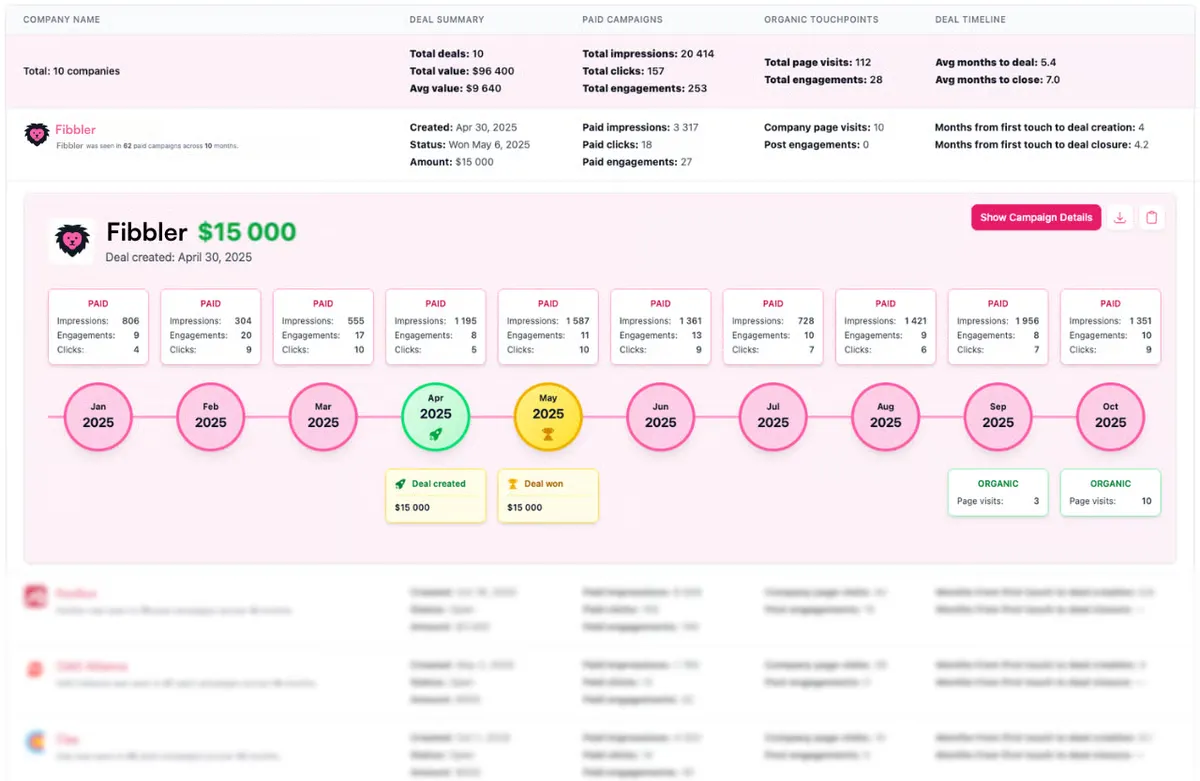
Understanding the interplay between brand awareness and demand capture is a significant first step, but proving this dynamic to executive stakeholders requires a tracking methodology that moves beyond the last-click model.
To bridge this gap, Fibbler aligns technical data with strategic intent, enabling organizations to move past fragmented reporting and gain a unified view of the buyer journey.
It accomplishes this through:
- Account-Level Attribution: Rather than tracking isolated clicks from individual users, Fibbler monitors how an entire target company interacts with a brand across LinkedIn, Google Ads and Meta Ads. This connects passive social impressions to later website visits, providing a more complete picture of account engagement.
- Deanonymizing Google Search Traffic: Fibbler's Google Ads add-on identifies the specific companies behind anonymous search clicks. This allows marketing teams to stop analyzing generic, unnamed visitors and start seeing which high-value accounts are actively researching their solution after being exposed to social content.
- Validating Brand Awareness: Organizations can instantly verify if the specific enterprise accounts targeted on LinkedIn are subsequently executing branded searches on Google. This provides the hard data necessary to validate a long-term brand awareness strategy, even when a direct click-through does not occur.
- Unified CRM Intelligence: Fibbler pushes these cross-channel insights directly into the CRM, such as Salesforce or HubSpot. This allows revenue leaders to see the exact sequence of events - from an initial LinkedIn video view in January to a Google Search conversion in March - within a single, unified timeline.
Stop Choosing, Start Connecting the Full Journey
The debate between brand awareness and demand capture misses the bigger picture, as you need both to thrive and scale in modern B2B markets. Right now, Google Ads is often the most efficient way to capture a buyer ready to purchase, while LinkedIn Ads remains one of the most effective tools for shaping the opinions of the people writing the checks.
Winning in 2026 requires fixing the measurement gap through account-level tracking rather than relying on isolated channel metrics. Fibbler identifies the companies behind your anonymous search clicks and connects them to your social campaigns, giving you a unified view of the entire revenue journey.
LinkedIn Ads vs Google Ads FAQs
Why does Google Search always look better than LinkedIn in my dashboard?
Standard "Last-Click" models favor the platform that captures intent. While Google Search harvests the final conversion, Fibbler reveals the 220-day "silent" phase where LinkedIn actually created the demand. Without it, you are effectively crediting the waiter for the work of the chef.
How does Fibbler track a journey that lasts 272 days?
Standard browser cookies often expire within 7 to 30 days, breaking the attribution trail. Fibbler uses server-side tracking and first-party data to maintain a persistent connection across the entire 272-day marathon, ensuring your early-stage LinkedIn touches aren't "lost" to history.
Can Fibbler see all stakeholders in a buying committee?
Yes. Unlike individual-based tracking, Fibbler aggregates data at the account level. It maps the interactions of all decision-makers, proving how social content built the consensus necessary to move a deal from a "silent" lead to a closed-won customer.
Is Fibbler worth it if my LinkedIn ICP cost is already low?
Even with a $257 ICP cost, you still want to understand Revenue Influence. Fibbler connects your ad spend to CRM outcomes, showing that LinkedIn engagement is associated with 28.6% larger deal sizes.
How does Fibbler improve my Google Ads efficiency?
By identifying which accounts are already "warmed up" via LinkedIn, Fibbler allows you to bid more aggressively on Search for high-value targets. This reduces the $560 Google ICP cost by ensuring you aren't overspending on generic, low-intent traffic.
Written by

Adam Holmgren
CEO @ Fibbler

Prove paid ads drive pipeline
Fibbler helps you see which companies view or engage with your LinkedIn, Google and Meta Ads, and connect them to pipeline and revenue in your CRM.
Try 30 days for free
Prove paid ads drive pipeline
Fibbler helps you see which companies view or engage with your LinkedIn, Google and Meta Ads, and connect them to pipeline and revenue in your CRM.
Try 30 days for free