

LinkedIn Ads
- LinkedIn Ads Revenue Attribution
- LinkedIn Ads Customer Journeys
- LinkedIn Ads CRM Sync
- LinkedIn Ads Optimization
- LinkedIn Ads Benchmarks

Google Ads

Meta Ads
Cross-Channel
Ad Signals
New



LinkedIn Ads Bid Strategies: Manual vs. Max Delivery vs. Cost Cap
Quick Summary
Manual Bidding, Maximum Delivery, and Cost Cap offer different levels of control and automation. This guide explains how each strategy works, when to use each, and why the cheapest clicks or cost per result do not necessarily mean the lowest-cost pipeline.
Why This Decision Matters More Than It Looks
Choosing a LinkedIn Ads bid strategy does more than determine how much control you have over bidding. It influences how LinkedIn enters the auction, how aggressively it spends your budget, and how it balances delivery against the cost of your chosen result.
The difference becomes more important as your audience, objective, and budget change. A strategy that works well for a broad awareness campaign may behave very differently when you target a small list of high-value accounts. Likewise, giving LinkedIn more freedom to optimize can simplify campaign management, but it may leave you with less control over what you pay to win each auction.
Understanding these tradeoffs makes it easier to choose the right strategy before you start spending, rather than trying to fix inefficient delivery after the campaign is already running.
Why Trust Us
Fibbler supports over 2,000 B2B advertisers using LinkedIn Ads. As an Official LinkedIn Marketing Partner, we also have access to LinkedIn’s Company Intelligence API, giving us a broader view of advertising and company-level data.
That experience spans thousands of campaigns, giving us a practical understanding of audience targeting, campaign setup, bidding, and attribution. It also gives us access to insights that standard LinkedIn Campaign Manager reporting doesn’t provide.
How the LinkedIn Ads Auction Works
Every LinkedIn ad competes in an auction when an opportunity to show it becomes available. Your bid matters, but it is not the only factor that determines whether your ad wins. LinkedIn also considers your ad’s relevance to the target audience and how likely it is to perform well.
The core mechanics are:
- Second-price auction: LinkedIn’s own auction guidance explains that the winning advertiser generally pays only enough to beat the next-highest competing bid, rather than the full bid. For example, a $1.40 bid can result in a $1.01 charge when the next-highest competing bid is $1.00.
- Bid: This is the amount used to compete for an auction opportunity. Manual Bidding lets you set the bid yourself, while automated strategies determine bids on your behalf.
- Relevance: LinkedIn considers predicted engagement and other performance signals alongside your bid. A higher bid therefore does not automatically guarantee the auction win.
The practical takeaway is that your bid influences how competitively you enter the auction, but it does not necessarily determine what you pay. The three strategies differ in how much control you retain over that bidding decision.
Manual Bidding
Manual Bidding is LinkedIn’s most hands-on bidding option. You set the bid amount yourself for your chosen objective rather than allowing LinkedIn to determine it automatically. It gives you direct control over how much you are willing to bid in the auction.
I tested manual bidding against automatic bidding using identical targeting, creatives, and ad format. The manual campaign started at one-third of LinkedIn’s recommended bid and was adjusted weekly to maintain full budget spend. After 30 days, both campaigns achieved roughly 0.80% CTR, while manual bidding produced about 20% lower CPC.
In practice, the experiment suggests a useful starting point:
- Start at roughly one-third of LinkedIn’s suggested bid
- Monitor delivery closely
- Adjust the bid when the campaign is not spending enough
Manual Bidding is particularly useful for narrow, account-based marketing (ABM) audiences. With a small, specific list of target accounts, direct bid control gives you more control over how aggressively you compete.
The result is not a universal benchmark. It is a test result showing that manual bidding can reduce CPC without sacrificing CTR when it is actively monitored and adjusted.
Best for: Narrow or ABM audiences, advertisers who want direct bid control, and teams willing to monitor delivery closely.
Maximum Delivery
Maximum Delivery, formerly called Automated Bidding, is LinkedIn’s fully automated option. There is no bid field. LinkedIn determines the bid for each auction, with the goal of spending your available budget while generating as many results as possible.
The main characteristics are:
- No bid field: LinkedIn sets the bid automatically based on its prediction of each auction opportunity
- CPM billing: You are charged based on impressions rather than a manually selected bid
- Full-budget delivery: The strategy is designed to spend the available budget while optimizing for your campaign objective
New Maximum Delivery campaigns can enter a learning phase as Campaign Manager gathers data about the campaign and its audience. LinkedIn positions automated bidding as a straightforward starting point for advertisers who want to minimize manual bid management.
There is a tradeoff, though. With automated bidding, LinkedIn manages the bid for each auction, reducing manual work but giving you less direct control over bid costs.
Best for: Broad audiences, advertisers who want minimal bid management, and campaigns where maximizing delivery matters more than maintaining tight control over bid costs.
Cost Cap
Cost Cap sits between Manual Bidding and Maximum Delivery. It is automated, but instead of giving LinkedIn complete control over delivery, you set a target for the average cost per result you want to achieve.
The key characteristics are:
- Automated bidding: LinkedIn determines the bid for each auction
- Target cost: You specify the average cost per result you want Campaign Manager to aim for
- Average, not a guarantee: Individual results can cost more or less than your target
WordStream’s breakdown illustrates the distinction with a $75 Cost Cap for lead generation. LinkedIn would aim for an average cost of around $75 per lead, rather than guaranteeing that every lead costs $75 or less.
LinkedIn’s documentation explains that the algorithm adjusts its bids based on how likely it predicts each auction opportunity is to produce the desired result, working toward your target cost over time.
The main risk is under-delivery. If your target is set too low for the auction conditions, LinkedIn may struggle to win enough auctions at that cost, and delivery can stall rather than simply exceeding your target.
That makes Cost Cap less attractive when:
- The audience is very small: There may not be enough data for the algorithm to optimize effectively
- The target cost is too aggressive: Delivery can slow or stop instead of exceeding the target
- You need consistent delivery: Maximum Delivery may be a better fit when spending the available budget matters more than maintaining a target cost
Best for:Lead generation and other conversion-focused campaigns where you want a predictable average cost, have a broad enough audience for the algorithm to learn from, and don’t need the direct bid control of Manual Bidding.
Comparison Table
| Criteria | Manual Bidding | Maximum Delivery | Cost Cap |
|---|---|---|---|
| Bid control | You set the exact bid | Fully automated, no bid field | You set a target cost; LinkedIn bids automatically |
| Billing basis | Objective’s billable action | CPM (impressions) | CPM (impressions), targeting your set cost per result |
| Oversight required | Regular monitoring recommended | Minimal | Occasional; watch for stalled delivery |
| Best audience size | Narrow / ABM | Broad | Broad to medium |
| Failure mode | Underbidding limits reach | CPM inflation on small audiences | Delivery can stall if the cap is too low |
| Objective availability | Widely available | Limited to supported objectives | Available for select objectives |
Sources: LinkedIn Help and LinkedIn Marketing Solutions for bid strategy mechanics and availability; WordStream for practitioner guidance and strategy comparisons.
Availability note: Bid strategy availability varies by campaign objective and ad format. LinkedIn also changes supported combinations over time, so check the options available in Campaign Manager before building a campaign around a specific strategy.
Decision Framework
Manual Bidding is the recommended starting point for most LinkedIn Ads campaigns. It gives you direct control over bid costs, while automated strategies trade that control for less manual management. The right choice still depends on your audience, objective, and need for delivery.
By Campaign Objective
Your objective should determine what kind of result you want the bidding strategy to optimize around.
- Lead generation: Cost Cap is a reasonable starting point when available, since it lets you target an average cost per lead
- Reach and awareness: Maximum Delivery is usually the simpler fit when the priority is maximizing exposure rather than hitting a specific cost per conversion
- Conversion-focused campaigns: Manual Bidding can make sense when you want tighter control over what you are willing to bid
By Audience Size
Audience size is one of the most important considerations because automated strategies need enough data and auction opportunities to optimize effectively.
- Broad audiences: Maximum Delivery or Cost Cap are generally better starting points
- Medium-sized audiences: Test Cost Cap against Maximum Delivery and compare both delivery and cost efficiency
- Narrow or ABM audiences: Manual Bidding gives you more direct control when the audience is too small for automated strategies to work efficiently
By Funnel Stage
Your funnel stage changes what you should prioritize.
- Top of funnel: Maximum Delivery generally fits campaigns focused on reach and awareness
- Mid funnel: Cost Cap can make sense when you have a defined conversion and want greater cost predictability
- Bottom funnel: Manual Bidding or Cost Cap can work when the campaign is tied to a high-value conversion and controlling acquisition costs matters more
A Practical Starting Point
For a new campaign, avoid committing the entire budget to one strategy before you know how it behaves.
Start with:
- 5% to 10% of planned spend as an initial test budget
- More than one strategy, if your budget allows meaningful testing
- The same audience and objective, where possible, so the bidding strategy is the main variable being compared
The goal is not simply to find the strategy with the cheapest clicks. It is to identify the strategy that produces the best combination of delivery, cost efficiency, and ultimately pipeline quality.
Measurement: The Number Your Bid Strategy Report Won’t Show You
Campaign Manager can tell you what each bidding strategy costs. It can show CPC, cost per result, spend, and delivery. What it cannot show is whether the companies reached at that cost eventually became pipeline or customers.
That creates an important measurement gap. A Cost Cap campaign can hit its target cost per lead while attracting companies with little buying potential. A Manual Bidding campaign might produce more expensive clicks but reach companies that ultimately enter your pipeline. The cheaper click is not necessarily the cheaper acquisition.
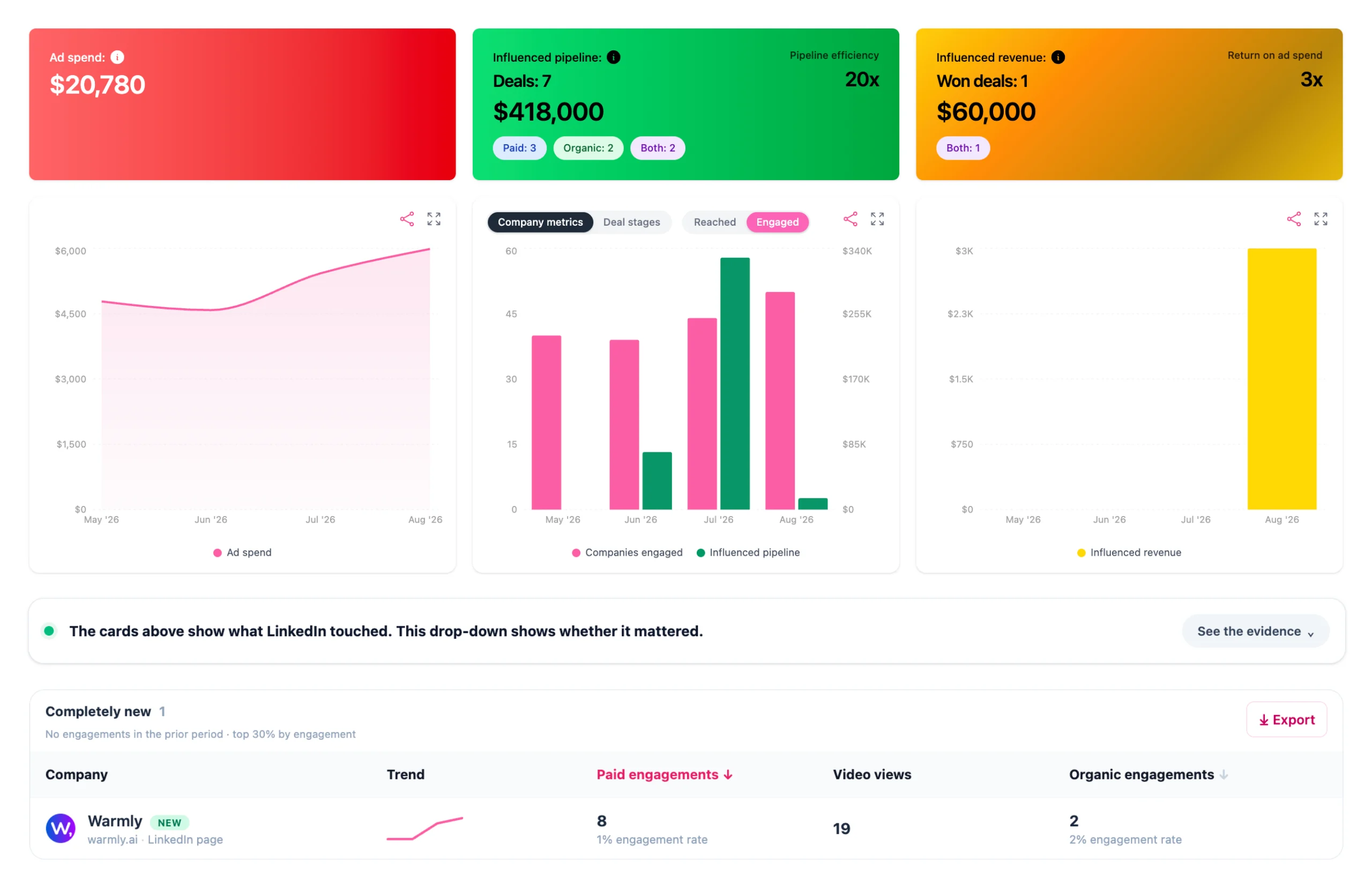
Fibbler closes that measurement gap by connecting LinkedIn ad exposure with CRM outcomes at the company level. Now, you can evaluate campaigns beyond the metrics available in Campaign Manager:
- Companies influenced: Which companies engaged with your LinkedIn campaigns
- Pipeline influenced: How much CRM pipeline is associated with those companies
- Revenue influenced: How much closed-won revenue those companies generated
- Campaign-level performance: How those outcomes differ between campaigns using different bidding strategies
This gives you a more useful way to evaluate a bid strategy. Instead of asking only whether it reduced CPC or cost per result, you can ask whether it produced better companies, more pipeline, and more revenue.
See Which Bid Strategy Actually Drives Pipeline
Stop judging bidding strategies by clicks alone. Connect LinkedIn Ads and your CRM in Fibbler to see which companies your campaigns influence and how that influence translates into pipeline and revenue.
Start your 30-day free trial at fibbler.co
Written by

Adam Holmgren
CEO @ Fibbler

Prove paid ads drive pipeline
Fibbler helps you see which companies view or engage with your LinkedIn, Google and Meta Ads, and connect them to pipeline and revenue in your CRM.
Try 30 days for free
Prove paid ads drive pipeline
Fibbler helps you see which companies view or engage with your LinkedIn, Google and Meta Ads, and connect them to pipeline and revenue in your CRM.
Try 30 days for free