

LinkedIn Ads
- LinkedIn Ads Revenue Attribution
- LinkedIn Ads Customer Journeys
- LinkedIn Ads CRM Sync
- LinkedIn Ads Optimization
- LinkedIn Ads Benchmarks

Google Ads

Meta Ads
Cross-Channel
Ad Signals
New



HockeyStack vs Dreamdata: Which B2B Attribution Tool is Right for You in 2026?
Quick Summary
We evaluated HockeyStack and Dreamdata across attribution depth, channel focus, pricing, and ideal use case. Plus a third option for teams whose core need is LinkedIn, Google and Meta Ads pipeline attribution without the enterprise price tag.
Why This Comparison Matters
HockeyStack treats attribution as one layer of a broader revenue intelligence motion. Dreamdata treats it as the core problem worth solving on its own.
That difference shapes which teams each platform is actually built for, and committing to the wrong one means weeks of implementation and a large annual contract before discovering it does not answer your actual questions.
This comparison covers what each platform is actually built for, and whether a lighter and more affordable tool covers your use case just as well.
Why Listen to Us
Fibbler is an official LinkedIn Marketing Partner and one of the first five companies with access to LinkedIn's Company Intelligence API. HockeyStack and Dreamdata both work with that API too.
With 2,000+ B2B advertisers on the platform and a 4.9/5 on G2, we have direct visibility into what teams actually need from attribution software, where these platforms deliver, and where they become more than the use case requires.
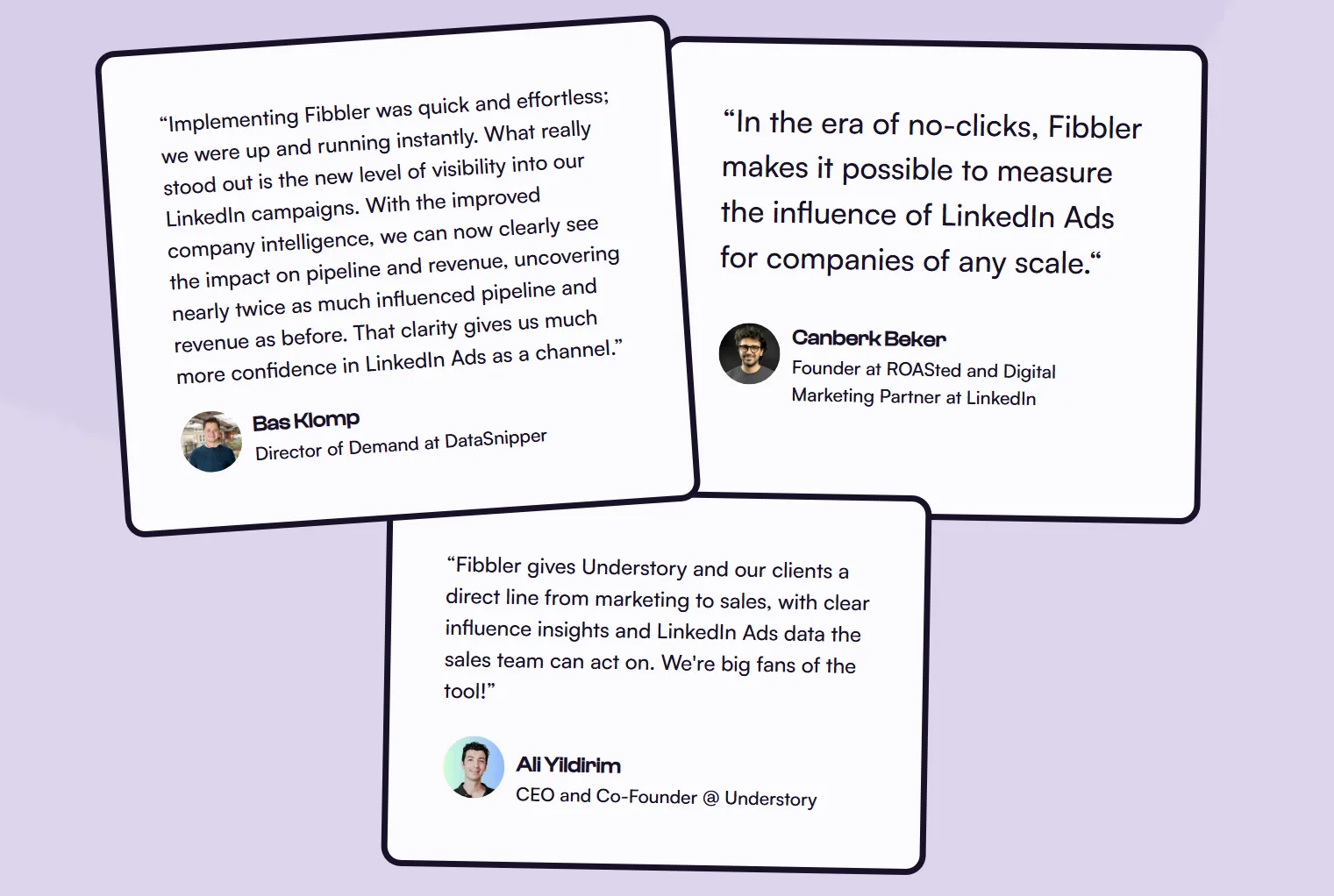
Here's what our customers say about us.
HockeyStack vs Dreamdata: Key Differences
| Tools | HockeyStack | Dreamdata |
|---|---|---|
| Attribution Depth | Predictive ML trained on closed-won data, retroactive reporting, and an AI analyst | Six standard models, custom models on the paid plan, and deep account-level journey mapping |
| Channel Focus | Unified marketing, sales, and product analytics. Strong for PLG and sales-led motions | Standard B2B digital stack (Ads, CRMs) with no product analytics layer |
| Pricing | No published pricing; plans are quoted by sales. Third parties report tiers starting around $1,399 a month on annual contracts. No free plan | Free plan at $0. The paid plan (Attribution & Activation) is custom-quoted, with a median of around $35,000 a year and annual contracts according to Vendr |
| Ideal Use Case | RevOps teams needing unified GTM intelligence, AI agents, and product data | Mid-market B2B teams running ABM and needing data warehouse access |
| G2 Rating | 4.5/5 (82 reviews) | 4.7/5 (271 reviews) |
Attribution Depth
Dreamdata goes deeper on pure attribution methodology with stronger account-level journey mapping and more standard models out of the box. HockeyStack's ML models are more sophisticated in learning from your own data, but attribution serves a broader GTM intelligence motion rather than being the end product.
Channel Focus
HockeyStack has broader channel coverage, particularly for PLG companies that need product usage data alongside marketing attribution. Dreamdata is stronger for pure marketing-to-revenue attribution across the standard B2B digital stack, with deeper LinkedIn-specific capabilities that matter for account-based programs.
Pricing
Dreamdata's free plan gives it a meaningful advantage for teams that want to evaluate before committing. HockeyStack has no free plan and a higher reported starting price at the paid tier, though for both paid plans you need a sales conversation before you know what you will actually pay.
HockeyStack vs Dreamdata: In-Depth Comparison
HockeyStack is a Go-To-Market (GTM) intelligence platform that includes attribution as one layer of a broader revenue motion, while Dreamdata is attribution-first. Dreamdata has also added audience activation, Signals, and (since September 2026) an AI analytics agent and an MCP server on top.
HockeyStack is built for revenue teams that need marketing, sales, and product data unified in one place. It pairs Odin, an AI analyst for marketing questions and campaign recommendations, with Revenue Agents that work on deals, accounts and forecasts, including inside Salesforce. It also has an MCP server, so you can query HockeyStack from Claude or ChatGPT. AI is central to what the product does, with attribution serving as the data foundation that powers it rather than the end goal.
Dreamdata is built specifically for B2B revenue attribution, connecting every digital touchpoint to pipeline and revenue through deep multi-touch journey mapping at the account level, with IP-to-company resolution that identifies up to 80 percent of anonymous company traffic.
Attribution Depth
HockeyStack
HockeyStack supports a comprehensive range of attribution models, from standard rule-based options to its proprietary Predictive model, which uses machine learning to weight touchpoints based on your company's specific closed-won patterns rather than a generic formula.
Its Blueprint machine learning layer reverse-engineers your winning deals to identify which sequences of touchpoints, channels, and sales interactions consistently appear before a deal closes, and it gets smarter with every new deal that completes.
Key attribution capabilities:
- Predictive ML model: Trained on your own closed-won data to weight touchpoints based on what actually predicts conversion in your specific pipeline, not industry averages.
- Blueprint ML: Identifies the precise GTM patterns behind your winning deals and replicates them across attribution modeling going forward.
- Retroactive reporting: Apply updated attribution models to historical data without rebuilding reports from scratch.
- Odin AI analyst: Ask complex attribution questions in plain English and receive visual analyses and recommendations rather than navigating dashboards manually.
Dreamdata
Dreamdata offers six out-of-the-box attribution models: first-touch, last-touch, linear, W-shaped, U-shaped, and data-driven. Teams can switch between models to compare how credit allocation changes, which is useful for understanding which channels to prioritize across a long B2B sales cycle.
The paid plan (Attribution & Activation) unlocks AI-based and custom attribution models, letting companies define exactly which touchpoints carry weight and how much, down to specific campaign types and offline interactions.
Key attribution capabilities:
- Six standard models plus custom: First-touch, last-touch, linear, W-shaped, U-shaped, and data-driven out of the box, with fully custom models available on the paid plan.
- Account-level journey mapping: Tracks every interaction from the first anonymous visit to closed revenue, connecting individual and account-level touchpoints across the full buying committee.
- IP-to-company resolution: Identifies up to 80 percent of anonymous company traffic visiting your site, surfacing companies that have never filled out a form.
- Data warehouse access: A data warehouse add-on (BigQuery, Snowflake and others) means attribution data can feed directly into external BI tools, custom dashboards or your own AI agents.
Verdict
Dreamdata goes deeper on pure attribution methodology with stronger account-level journey mapping and more standard models out of the box. HockeyStack's ML models are more sophisticated in learning from your own data, but attribution serves a broader GTM intelligence motion rather than being the end product.
Channel Focus
HockeyStack
HockeyStack unifies data across marketing, sales, and product analytics in a single platform, making it particularly strong for companies running both sales-led and product-led growth motions simultaneously. Its warehouse-native architecture connects to CRMs, ad platforms, marketing automation tools, data warehouses, and product analytics systems through APIs, SDKs, and reverse ETL syncs.
Offline data like event spend and offline conversions can be synced in too, but that takes some setup work on your side.
Key channel coverage:
- Paid advertising: Google Ads, LinkedIn Ads, and all major ad platforms with campaign-level visibility, though granular ad-creative-level impression data is limited across the category.
- Product analytics: Connects in-product behavior directly to revenue outcomes, attributing upsells, churn, and expansion to specific user actions, a capability that matters for PLG companies.
- Sales activity: Revenue Agents surface in-market accounts and automate sales tasks, including inside Salesforce, based on unified GTM data.
- Offline channels: Supported via API but requires manual configuration rather than native out-of-the-box tracking.
Dreamdata
Dreamdata's channel coverage is built specifically around the standard B2B digital stack, with particular strength in connecting paid ad platforms, web analytics, CRM pipeline, and intent data into a clean account-level data model. Its Audience Hub syncs precise segments directly back into major ad networks, and its LinkedIn Conversions API and Company Intelligence integrations make it a strong platform for LinkedIn-specific attribution.
Where Dreamdata has less coverage is product analytics. It is primarily a marketing-to-revenue attribution platform and goes less deep on connecting in-product behavior to commercial outcomes than HockeyStack does.
Key channel coverage:
- Paid advertising: Deep integration with LinkedIn Ads, Google Ads, and other major ad platforms, with the ability to sync audiences back into those platforms directly.
- LinkedIn specifically: Native LinkedIn Conversions API and Company Intelligence API integrations give Dreamdata strong LinkedIn attribution depth.
- CRM and marketing automation: Integrations with HubSpot, Salesforce, Microsoft Dynamics, Pipedrive and Zoho, plus major marketing automation tools, as the core data foundation.
- Intent data: Signals surface high-intent accounts from web and ad engagement and push notifications directly to sales.
Verdict
HockeyStack has broader channel coverage, particularly for PLG companies that need product usage data alongside marketing attribution. Dreamdata is stronger for pure marketing-to-revenue attribution across the standard B2B digital stack, with deeper LinkedIn-specific capabilities that matter for account-based programs.
Pricing
Neither platform publishes its paid pricing. For both, you need a demo before you see real numbers. Dreamdata does publish a free plan.
HockeyStack
HockeyStack doesn't show plan names or prices on its pricing page. Third-party sources describe two quote-based tiers, GTM Intelligence and GTM Execution. GTM Intelligence reportedly includes attribution, the Odin AI analyst, scoring, enrichment, and Salesforce iFrame. GTM Execution adds the Custom Agent Builder, the full AI agent suite, and higher usage limits.
Based on third-party procurement data, GTM Intelligence starts at approximately $1,399 per month for 10,000 monthly tracked users, with GTM Execution running closer to $2,200 per month or more. Median annual contracts are reported to be around $28,000, and standard plans are billed annually. HockeyStack also runs a smaller invite-only pilot for SMB teams.
Dreamdata
Dreamdata's paid plan, Attribution & Activation, is also quote-based. Everything beyond the free plan needs a demo and a custom quote. According to Vendr, the median buyer pays around $35,000 a year, sold as an annual subscription, and the price depends on how many accounts you track.
Unlike HockeyStack, Dreamdata offers a genuinely usable free plan that gives smaller teams access to foundational analytics before committing to a paid tier, which meaningfully lowers the evaluation barrier.
Verdict
Dreamdata's free plan gives it a meaningful advantage for teams that want to evaluate before committing. HockeyStack has no free plan. At the paid tier, HockeyStack's reported starting price is higher, though both platforms ultimately require a sales conversation and an annual contract before you know what you will actually pay.
Ideal Use Case
HockeyStack
HockeyStack is built for revenue teams that need more than attribution reporting. Its strength is unifying marketing, sales, and product data into a single intelligence layer that powers both human decision-making and AI-driven automation across the entire GTM motion.
HockeyStack is the right choice for:
- Revenue operations teams: Best suited for RevOps and marketing ops teams that need a single source of truth across marketing, sales, and product data rather than managing separate tools for each function.
- PLG and sales-led hybrid motions: Strong for companies running both product-led and sales-led growth simultaneously, where product usage data needs to sit alongside marketing attribution.
- AI-driven GTM workflows: Teams that want AI agents to surface insights, automate outreach, and run account-level workflows rather than building manual reports and playbooks.
- Enterprise teams managing large campaign volumes: Well-suited for larger organizations with high ad spend that need attribution to scale reliably across dozens of campaigns and channels simultaneously.
- Teams consolidating fragmented data stacks: Companies whose data is split across Salesforce, HubSpot, ad platforms, and spreadsheets will find HockeyStack's unified data foundation eliminates manual stitching.
Dreamdata
Dreamdata is built specifically for B2B marketing teams that need deep, reliable revenue attribution across digital channels, connecting ad spend and web activity to CRM pipeline at the account level.
Dreamdata is the right choice for:
- Mid-market B2B teams with long sales cycles: Strong for companies with multi-stakeholder buying committees and extended sales cycles, where standard last-touch attribution misses most of the story.
- Marketing-to-revenue attribution focus: Teams whose primary need is understanding which campaigns, channels, and content assets drive pipeline and closed revenue without needing a broader GTM intelligence layer.
- Account-based marketing programs: Teams running ABM programs benefit from Dreamdata's ability to connect ad engagement to specific target accounts and sync audiences back into LinkedIn and Google Ads based on real buying signals.
- Data warehouse users:Teams that need attribution data to flow into BigQuery or Snowflake for custom analysis and external BI dashboards will find Dreamdata's data warehouse add-on a strong fit.
- Standard B2B digital stacks: Works best for teams whose primary channels are Google Ads, LinkedIn Ads, Salesforce, or HubSpot, and marketing automation. Teams with heavily custom data sources may hit integration limits.
An Alternative to HockeyStack & Dreamdata: Fibbler
If you have read through this comparison and neither platform feels like the right fit, it is probably because your attribution needs are more focused than what either platform is built for. You are not trying to unify your entire GTM motion with AI agents or build a full multi-touch attribution layer across every digital touchpoint in your tech stack.
You want to know which LinkedIn, Google and Meta Ads campaigns are linked to pipeline and closed revenue in your CRM, and you want that answer without a five-figure annual contract, weeks of setup, or a demo just to see what it costs. That is exactly what we designed Fibbler for.
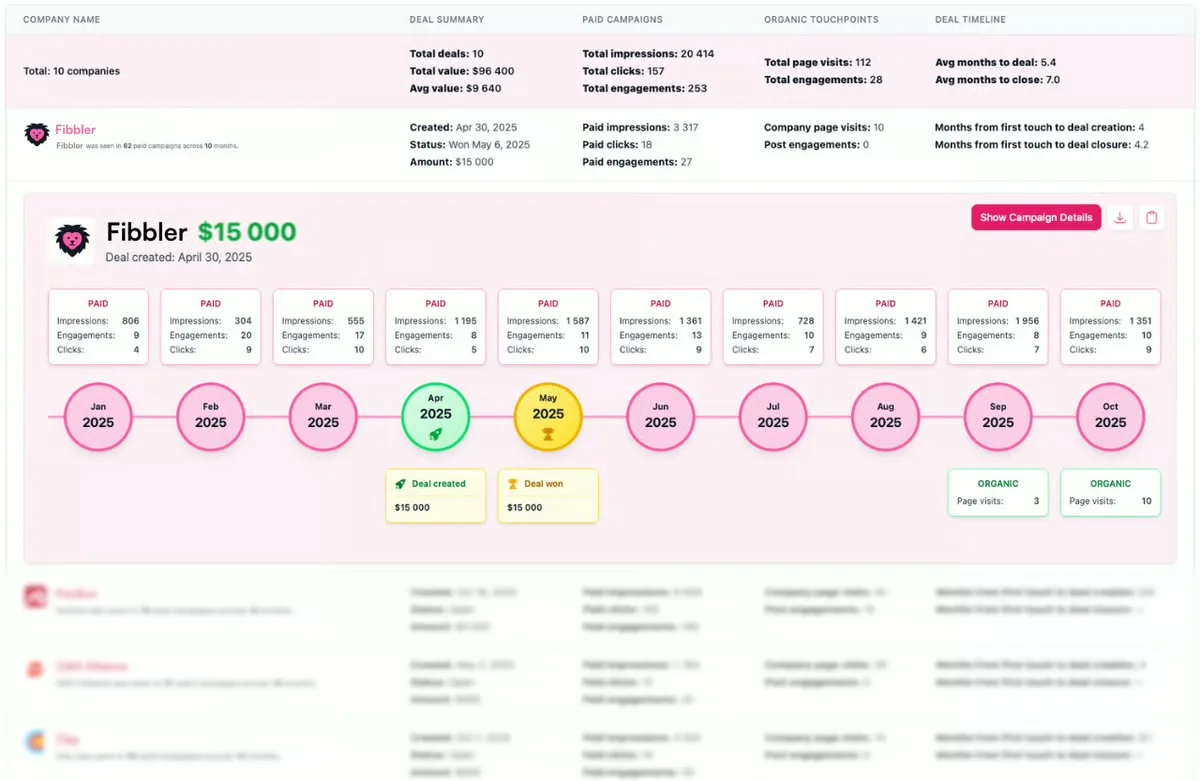
Fibbler is an official LinkedIn Marketing Partner and one of the first five companies with access to LinkedIn's Company Intelligence API. It identifies which companies are engaging with your LinkedIn Ads and organic posts, maps that activity to pipeline and revenue in HubSpot, Salesforce, Attio, or Pipedrive, and lets you cap impressions on accounts that are not moving. Fibbler is also SOC 2 Type 1 compliant, with all customer data hosted in the EU.
Pricing is fully published, starting at $89 per month, with a 30-day free trial and no annual contract required.
Why People Choose Fibbler
- Built around paid ads: Fibbler is an official LinkedIn Marketing Partner and focuses only on paid ads. Teams whose core question is LinkedIn Ads performance get that answer at the center of the product, not inside a broader GTM platform.
- Published pricing: Pricing starts at $89 per month with no demo required to see the numbers. HockeyStack's estimated $1,399-a-month entry point and Dreamdata's paid plan are both quoted through a sales call.
- Campaign-level pipeline and CRM attribution: Fibbler maps LinkedIn Ads campaigns to pipeline and closed revenue in HubSpot, Salesforce, Attio, or Pipedrive, so teams can see which campaigns are linked to revenue without standing up a data warehouse or unifying their entire GTM stack first.
- Same-day setup, no annual lock-in: Connect your accounts and you have attribution data the same day, with no annual contract required. Paid plans at HockeyStack and Dreamdata are typically annual contracts.
- Budget control built in: Fibbler identifies which companies are engaging with your LinkedIn Ads and lets you cap impressions on accounts that are not moving, so you can act on the data and not just report on it.
- Ad Signals:Fibbler sends the companies engaging with your LinkedIn ads (and Google and Meta ads with the add-ons) straight to where your sales team already works: Slack, Microsoft Teams, your CRM, or Clay, Zapier, n8n and Make. It's simple to set up and runs on its own once it's on.
- Multi-channel coverage with the Google Ads and Meta Ads add-ons: Beyond LinkedIn, these add-ons bring all three paid channels into one attribution view, giving leaner teams the multi-channel picture without the overhead of a full revenue intelligence platform.
Conclusion
Get focused LinkedIn, Google and Meta Ads attribution tied directly to your CRM pipeline, without the enterprise complexity, five-figure contracts, or weeks of setup.
Start your 30-day free trial at fibbler.co.
Written by

Adam Holmgren
CEO @ Fibbler

Prove paid ads drive pipeline
Fibbler helps you see which companies view or engage with your LinkedIn, Google and Meta Ads, and connect them to pipeline and revenue in your CRM.
Try 30 days for free
Prove paid ads drive pipeline
Fibbler helps you see which companies view or engage with your LinkedIn, Google and Meta Ads, and connect them to pipeline and revenue in your CRM.
Try 30 days for free