

LinkedIn Ads
- LinkedIn Ads Revenue Attribution
- LinkedIn Ads Customer Journeys
- LinkedIn Ads CRM Sync
- LinkedIn Ads Optimization
- LinkedIn Ads Benchmarks

Google Ads

Meta Ads
Cross-Channel
Ad Signals
New



LinkedIn Ads vs Meta Ads for B2B: Which One Actually Builds Pipeline?
Quick Summary
LinkedIn Ads reaches your buying committee by job title, seniority, and company size. Meta Ads (Facebook and Instagram) reaches many more people for far less but can’t reliably filter for B2B roles. Meta wins on cost per lead ($25-$60 vs. LinkedIn’s $75-$150), but cost per lead isn’t cost per qualified lead.
Measured on pipeline instead, LinkedIn delivers 121% ROAS against Meta’s 51%, per Dreamdata’s 2026 benchmarks. LinkedIn builds pipeline among the people who actually buy while Meta earns its budget retargeting and capturing demand LinkedIn already created.
The Comparison That Sends B2B Budgets to the Wrong Place
Most B2B teams pick a paid social channel the same way. They pull up cost per lead for LinkedIn and Meta, see LinkedIn running two to five times higher, and start shifting budget toward Meta. It’s an easy comparison to make, because CPL is the one number both platforms hand you for free, with no extra tooling required.
It’s also the wrong comparison. LinkedIn’s Campaign Manager only credits a conversion to a direct click or an on-platform form fill.
Meta’s default settings count anything that happens within seven days of a click, or within one day of someone simply seeing the ad without clicking at all. Two platforms, two different definitions of what counts as a result, stacked into the same table as if they measure the same thing.
It’s a version of the same mistake we’ve written about with LinkedIn Ads and Google Ads, where teams default to whichever channel’s dashboard shows the friendliest number instead of the one actually building pipeline.
Every comparison ranking for this exact topic lines up CPL side by side and stops there. None of them ask whether the leads are the same quality, or whether the tracking windows are even measuring the same behavior. That’s the gap this piece is built to close.
Why Listen to Us
We built Fibbler to connect LinkedIn Ads data to CRM pipeline and revenue, so B2B marketers can see which companies are actually engaging with their ads. We’re an official LinkedIn Marketing Partner with direct access to LinkedIn’s Company Intelligence API, and we’re rated 4.9/5 on G2 from marketers who’ve run into exactly this attribution problem.
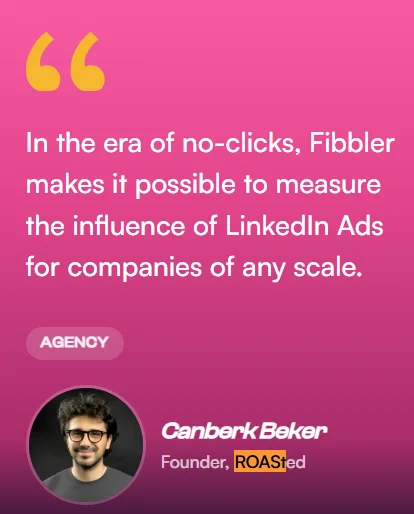
“In the era of no-clicks, Fibbler makes it possible to measure the influence of LinkedIn Ads for companies of any scale,” says Canberk Beker, Founder at ROASted. Ali Yildirim, CEO at Understory, agrees, saying Fibbler gives his team and their clients “a direct line from marketing to sales, with clear influence insights and LinkedIn Ads data the sales team can act on.”
We see the rigged-CPL problem this article describes play out in customer accounts every week, with teams under pressure to justify LinkedIn spend against a Meta number that was never measuring the same thing.
LinkedIn Ads vs Meta Ads at a Glance
Before going deeper, here’s how the two platforms stack up across the factors that actually matter for a B2B program.
| Factor | LinkedIn Ads | Meta Ads | What it means for B2B |
|---|---|---|---|
| Targeting inputs | Job title, seniority, company size, industry, skills | Interests, behaviors, lookalike audiences, CRM custom audiences | LinkedIn lets you target the buying committee by role. Meta can only approximate it. |
| Audience size | Over 1 billion members worldwide | Over 3 billion combined monthly active users across Facebook and Instagram | Meta reaches more people, but most of them aren’t your ICP. |
| Typical CPC | $6-$12 | $1-$3 | LinkedIn’s premium buys verified professional identity, not just a click. |
| Typical CPM | $30-$60 | $5-$15 | Every LinkedIn impression reaches a verified professional profile. |
| Typical CPL | $75-$150 | $25-$60 | The number every comparison leads with, and the one that hides the most. |
| Minimum viable monthly budget | $1,500-$3,000 | $300-$1,000 | LinkedIn needs more spend before campaign data is statistically meaningful. |
| Best-fit funnel stage | Top and mid-funnel awareness among ICP accounts | Retargeting and broad demand capture | LinkedIn creates demand; Meta captures it once it exists. |
| Ad formats that work | Single image, carousel, video, conversation ads | Video, carousel, lead ads, retargeting display | Both platforms handle video well; LinkedIn’s native formats fit a professional feed. |
| CRM and measurement integration | Native reporting stops at clicks; needs third-party attribution for pipeline | Pixel-based tracking with view-through windows; same gap applies | Neither platform tells you what happened after the lead without added attribution. |
| Buying committee visibility | Can target CFOs, VPs of Marketing, and Directors separately | No reliable way to target by professional role | If your deal involves five or more stakeholders, only LinkedIn reaches them by title. |
Source: Cost and budget ranges reflect aggregated 2026 B2B advertiser benchmarks; actual costs vary by industry, targeting, and competition.
Targeting: Professional Identity vs Behavioral Signals
LinkedIn’s targeting runs on data people volunteer about their working life, such as job title, seniority, function, company name, company size, industry, and skills. Say your ICP is VPs of Marketing at SaaS companies with 50 to 500 employees. You can build that exact audience and know the impressions are landing on the right desks.
Meta has no real equivalent. Its targeting runs on interests, behaviors, and lookalike modeling rather than verified professional data, and job-title signals come from whatever people have listed or engaged with, not something actively maintained the way a LinkedIn profile is.
A VP of Sales who follows cooking pages and a student who liked a “productivity hacks” post can end up looking identical to Meta’s targeting engine.
CRM custom audiences narrow the gap somewhat. Upload a contact list and Meta builds a matched audience from it, but B2B email lists typically match at lower rates than consumer lists, so the usable audience often ends up smaller than what was uploaded.
The practical difference is that LinkedIn targets who someone is at work, while Meta targets what someone seems interested in. For reaching a buying committee, the first is worth paying a premium for.
What Each Channel Actually Costs in B2B
LinkedIn Ads costs more per click, per impression, and per form fill. Here’s what that premium looks like in 2026 B2B benchmarks:
LinkedIn Ads
- CPC: $6-$12
- CPM: $30-$60
- CPL: $75-$150
- Minimum viable monthly budget: $1,500-$3,000
Meta Ads
- CPC: $1-$3
- CPM: $5-$15
- CPL: $25-$60
- Minimum viable monthly budget: $300-$1,000
These are aggregated ranges, not fixed prices. Your numbers will move with industry, targeting, and competition. But the pattern holds across most B2B verticals, with LinkedIn costing three to five times more per lead than Meta. On CPL alone, that makes Meta look like the obvious call. It isn’t the whole picture, and the next section is why.
Why the Cost Comparison Everyone Publishes Is Rigged
Every comparison on this topic stacks LinkedIn’s CPL against Meta’s and stops there. That comparison has three problems baked into it, and none of them show up in Campaign Manager or Ads Manager.
The last-click bias that flatters Meta
Meta’s default attribution window credits a conversion if it happens within seven days of a click, or within one day of someone simply viewing the ad. LinkedIn’s native reporting only counts conversions tied to a direct click or an on-platform form fill.
In B2B, the buying journey now averages 272 days, with roughly the first seven months spent in what Dreamdata’s 2026 benchmarks call a “silent” phase consisting of research and internal discussion happening off any trackable click.
A seven-day window doesn’t capture any of that. So when a $120 LinkedIn CPL gets compared to a $35 Meta CPL, the two platforms aren’t measuring the same behavior. Meta is simply claiming credit for a much wider slice of activity around the same conversion event.
The click-rate problem that hides LinkedIn’s impact
Most people who see a LinkedIn ad never click it. Commonly cited benchmarks put average click-through rate on LinkedIn Sponsored Content at well under half a percent, meaning for every thousand impressions, only a handful of clicks ever register.
That’s not a LinkedIn weakness so much as a picture of how B2B buyers actually behave. They see an ad, register the brand, and weeks later search for the category directly or visit the site on their own, with no click ever tying that visit back to the ad that built the awareness.
None of that shows up in native reporting. Three people at a target account see a LinkedIn campaign over two months. The company closes as a deal in Salesforce.
Nobody clicked anything, so LinkedIn shows zero conversions, and the CRM credits the close to whatever touched it last, which is often a cold outbound email that landed the week before signing.
Without company-level attribution connecting impressions to CRM pipeline, LinkedIn will always look more expensive than it is, and whichever channel sits closest to the final conversion will always look artificially cheap.
What happens to those cheap leads after the form fill
StraightIn ran the cleanest public test of this in 2025, putting LinkedIn and Meta head to head with the same lead magnet, the same budget (£8 a day, LinkedIn’s platform minimum) and the same seven-day window.
Meta filled the funnel faster and cheaper. But 51% of Meta’s leads fell completely outside the target ICP, with wrong industries, wrong company sizes, and people with plausible-looking job titles but no real buying authority. LinkedIn’s ICP match rate was 83%.
That gap has a real cost.
Sales still has to qualify every lead that comes in, and when more than half of what one channel sends isn’t even in the target market, the time spent filtering eats into whatever was saved on CPL.
Add the follow-up emails and discovery calls that go nowhere, and the difference between a $35 lead and a $120 lead gets a lot smaller than the dashboard suggests.
What the Numbers Look Like When You Measure Pipeline Instead of Leads
Dreamdata’s 2026 benchmarks tracked B2B ad spend all the way to closed revenue instead of stopping at the conversion event, and the CPL ranking flips:
- LinkedIn Ads ROAS: 121%, meaning for every $1 spent, $1.21 came back in attributed revenue
- Google Search ROAS: 67%
- Meta Ads ROAS: 51%
LinkedIn also captured 41% of B2B paid social budgets in 2025, per the same report, making it the largest share of any platform tracked, and itself a signal that revenue-focused marketers are already voting with spend once they look past CPL.
None of this makes Meta worthless.
It means the channel that looks most expensive on a lead-by-lead basis is the one actually returning revenue, and the channel that looks cheapest is returning less than it costs. Cost per lead measures how fast the funnel fills. ROAS measures whether the funnel produces anything worth having.
Where Meta Earns Its Place in a B2B Program
None of this is an argument to drop Meta. It’s an argument for using it for the job it’s actually good at, which isn’t generating cold, first-touch B2B leads.
Retargeting engaged accounts. Take the companies that engaged with a LinkedIn campaign and build a Meta custom audience from their contacts. It keeps the brand in front of the same buying committee on Facebook and Instagram at a fraction of LinkedIn’s cost per impression.
Reaching the rest of the buying committee. A typical B2B deal now involves ten stakeholders, according to Dreamdata’s 2026 data.
LinkedIn Ads reliably reach the VP of Marketing and the Director of Demand Gen; the CFO or a technical evaluator may spend more of their attention on Meta’s properties. Retargeting there keeps the whole committee warm, not just the people most active on LinkedIn.
Running video at scale. A strong brand video costs far less to distribute on Meta’s CPM. Use LinkedIn to reach the right few hundred accounts precisely, then use Meta to make sure the people at those accounts see it more than once.
Meta works as a complement to LinkedIn-generated awareness, not a cheaper substitute for it. Every dollar shifted to Meta because its CPL looks better is a dollar that stops reaching the buying committee by name, and there’s nobody to retarget until LinkedIn, or some other channel, creates the initial engagement to retarget against.
How Should B2B Teams Split Budget Between LinkedIn and Meta?
Start most B2B programs at roughly 70% LinkedIn, 30% Meta, then adjust based on what pipeline data shows, not what lead volume does.
That starting split holds because LinkedIn is where pipeline gets built, and Meta is where it gets extended. From there:
Shift more toward LinkedIn (80/20 or higher) if:
- Average contract value is above $25,000 and the buying committee runs five or more people
- The ICP maps to a specific, targetable professional persona
- There isn’t yet a large enough engaged or customer list to make Meta custom audiences worth running
Shift more toward Meta (60/40) if:
- There’s already a proven retargeting list built from LinkedIn engagement
- Deal size is lower and the sales cycle is short
- The LinkedIn audience is saturated and frequency is climbing without new reach
The one mistake to avoid is splitting budget based on CPL. A team that moves spend to Meta because its CPL reads $35 against LinkedIn’s $120 will usually see lead volume climb and pipeline shrink because the comparison that triggered the shift was never measuring the same thing to begin with.
Decide the split on pipeline contribution, not on whichever number is cheapest to pull from Ads Manager.
How to Measure Both Channels in One Place
LinkedIn and Meta report into two separate dashboards that don’t talk to each other or to the CRM. Each one can tell you what it did in isolation. Neither can tell you, three months later, which channel’s ads actually influenced the deal that just closed.
Company-level attribution closes that gap by matching ad engagement from every channel to the companies moving through pipeline.
Fibbler does this for LinkedIn Ads, and the Meta Ads add-on is live today for teams running both channels. It works the same way as the Google Ads add-on, identifying the companies behind your Facebook and Instagram ad clicks and syncing them straight to the CRM. It costs $59/month and comes with a 14-day free trial.
The cross-channel view puts every paid channel’s spend, Meta included, next to the pipeline it actually touched, so a budget split like the one above can be tested against real data instead of assumptions.
If you’re weighing attribution options more broadly, our roundup of B2B marketing attribution software covers where Fibbler fits alongside tools like Dreamdata and HockeyStack. Fibbler plans start at $89/month with a 30-day free trial, no credit card required. See how it works.
LinkedIn Ads vs Meta Ads FAQs
Is LinkedIn or Meta better for B2B advertising?
It depends on the job. LinkedIn is better for reaching B2B decision-makers directly, because you can target by job title, seniority, and company size, and the audience is verified as professional. Meta is better for retargeting and broad awareness at a much lower cost, but it can’t reliably reach people by professional role.
Most B2B programs that perform well use both, with LinkedIn driving awareness among the ICP and Meta retargeting and extending that reach.
Why are LinkedIn Ads so much more expensive than Meta Ads?
Because the premium buys verified professional identity, not just an impression. LinkedIn’s CPC typically runs $6 to $12 versus $1 to $3 on Meta, and CPL runs three to five times higher. That cost reflects certainty that the person seeing the ad is who their profile says they are, which is something Meta’s interest-based targeting can’t guarantee.
Can I target by job title on Meta Ads?
Not reliably. Meta lets you layer in job-title-related interests, but that data comes from what people have listed or engaged with, not verified or actively maintained the way LinkedIn’s professional data is.
Two people with the same listed job title on Meta can have very different buying authority, which is part of why 51% of Meta’s leads fell outside the target ICP in StraightIn’s head-to-head test, despite targeting the same titles LinkedIn was given.
Do I need a large budget to test LinkedIn against Meta?
No. A meaningful side-by-side test can run on roughly $1,500 to $2,000/month on LinkedIn and $500 to $800/month on Meta. What matters more than budget size is giving the test long enough to see pipeline rather than just lead volume, which means 60 to 90 days at minimum, since B2B sales cycles typically outlast either platform’s default attribution window.
Should I run LinkedIn and Meta Ads at the same time?
Yes, but give them different jobs rather than running identical campaigns and comparing CPLs. Use LinkedIn to build awareness among ICP accounts, and use Meta to retarget the people and companies who’ve already engaged. Comparing the two on cost per lead alone will make Meta look better every time, because the platforms don’t count a “lead” the same way.
Written by

Adam Holmgren
CEO @ Fibbler

Prove paid ads drive pipeline
Fibbler helps you see which companies view or engage with your LinkedIn, Google and Meta Ads, and connect them to pipeline and revenue in your CRM.
Try 30 days for free
Prove paid ads drive pipeline
Fibbler helps you see which companies view or engage with your LinkedIn, Google and Meta Ads, and connect them to pipeline and revenue in your CRM.
Try 30 days for free