

LinkedIn Ads
- LinkedIn Ads Revenue Attribution
- LinkedIn Ads Customer Journeys
- LinkedIn Ads CRM Sync
- LinkedIn Ads Optimization
- LinkedIn Ads Benchmarks

Google Ads

Meta Ads
Cross-Channel
Ad Signals
New



8 Best Metadata.io Alternatives for B2B Attribution in 2026
Quick Summary
Metadata.io is strong at running ads for you with AI across a lot of channels. But it's priced on request for teams with real ad budgets, and it does a lot more than some teams need. If you mainly want to see how your ads line up with pipeline, there are more focused options.
Here are our top three alternatives:
| Tool | Best For |
|---|---|
| Fibbler | LinkedIn API & Revenue Attribution |
| Factors.ai | Multi-channel Attribution |
| HockeyStack | AI Agents for Revenue Teams |
Looking for a Metadata.io Alternative?
Metadata.io is known for autonomous B2B advertising, using AI to build audiences, create ads and launch and optimize campaigns across 12 channels. Its MetaMatch engine matches business and personal identities, so B2B ads can reach the right people even on Facebook and Instagram.
It's a big platform, though, and it's priced that way. If you mainly need attribution, or you run most of your ads on one channel, you may be paying for a lot you don't use.
If that sounds like you, here are 8 alternatives to Metadata.io that may fit your team's stage, workflow and tech stack better.
Why Trust Us
We launched Fibbler after seeing B2B teams struggle to measure their most expensive channel, LinkedIn. Working with companies like DataSnipper and ROASted showed us how much gets lost between ad impressions and the deals in the CRM.
Here's how one customer describes switching to an attribution-first approach:
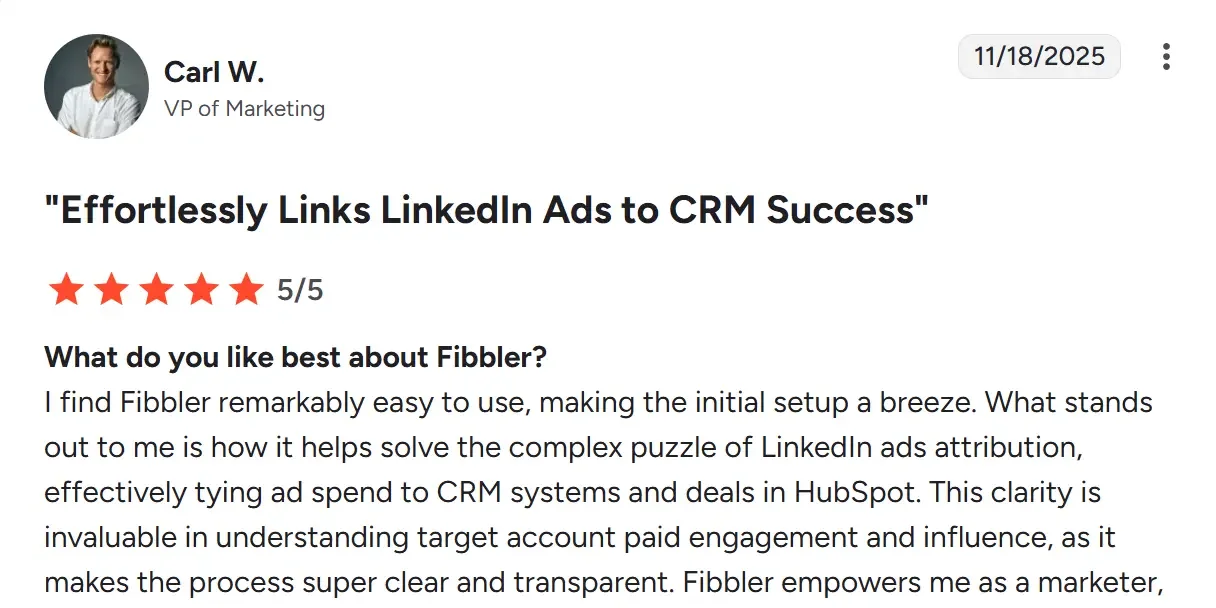
Based on what we see building attribution for B2B teams every day, these are 8 Metadata.io alternatives worth a look.
What Is Metadata.io
Metadata.io is an autonomous B2B advertising platform. A team of named AI agents plans campaigns, builds audiences, creates ads and landing pages, launches campaigns and reports on results across 12 channels, including LinkedIn, Google, Meta, X, Reddit, Bing, ChatGPT, display and CTV.
Demand gen teams at companies like Zoom use it to run more campaigns with less manual work. Its core features include:
- MetaMatch Audience Engine: Matches business and personal identities across 1.5B emails for B2B targeting on channels like Facebook
- Autonomous Multivariate Testing: Generates and tests hundreds of creative and audience combinations
- AI Bid & Budget Management: Shifts spend toward the campaigns that bring in CRM pipeline
- Insights: Shows which companies view, engage with or convert on your ads, with account journeys and pipeline from Salesforce or HubSpot
- MCP and ChatGPT app: Connect your own AI tools to your Metadata data
Metadata.io is best suited for mid-market and enterprise teams running sizeable multi-channel ad programs.
Metadata also launched Pixel, a simpler product where you describe what you want and it builds, launches, and optimizes campaigns for you. It brings the same infrastructure to a broader audience, though it's positioned as a campaign builder rather than an attribution tool.
Why Consider Metadata.io Alternatives?
Metadata.io does a lot well, but it isn't the right fit for every team. These are the most common reasons teams look at alternatives:
1. Attribution That's Hard to Audit
Metadata moves budget automatically toward what it sees working, which saves time. But some reviewers find it hard to see why a specific ad got credit for a deal.
One G2 reviewer put it simply: the attribution isn't "surgically precise."
2. Cost
Metadata doesn't publish prices. Its pricing page says pricing is scoped per team after a demo, based on your channels, the ad spend Metadata manages and the work you hand over. Third parties report platform fees of around $3,000 to $6,000 or more a month, rising with managed ad spend. That's a lot if you only need one piece, like attribution or audience sync.
3. A Lot to Learn at First
One verified G2 user noted the platform "feels complex and a bit overwhelming at first." Running many campaigns and experiments across 12 channels is powerful, but it's easier to get value from it if someone on the team owns the platform.
4. Built Around Sourced Pipeline
Metadata says itself that it focuses on sourced pipeline, the deals its campaigns create. If most of your ads are about reaching and warming up target accounts, you may want a tool that reports on influenced pipeline too.
Our Top 8 Metadata.io Alternatives for 2026
| Tool | Best For | Core Strength | Why Choose It Over Metadata.io | G2 Rating | Pricing |
|---|---|---|---|---|---|
| Fibbler | LinkedIn-First Teams | Deep LinkedIn API Attribution | Focused only on how your paid ads line up with pipeline, with published pricing at a fraction of the cost. | 4.9 | $89-$159/mo |
| Factors.ai | Multi-Channel Attribution | Identity Resolution & Path Mapping | Faster setup and more transparent data logs; ideal for mid-market teams. | 4.8 | Free plan, paid from $6,000/yr |
| HockeyStack | AI Agents for Revenue Teams | Unified Revenue Analytics | Connects marketing, product usage, and CRM data into one timeline. | 4.9 | Custom |
| Dreamdata | Complex B2B Journeys | B2B Revenue Data Platform | Strong at cleaning messy CRM data and mapping long-cycle enterprise deals. | 4.7 | Free plan, paid on request |
| 6sense | Enterprise ABM | Predictive Intent & AI Insights | Deeper intent data and buying stage predictions for deciding who to target. | 4.3 | Custom |
| Demandbase | Full-Suite ABM | Account Intelligence & Advertising | Covers more of the ABM motion in one place for large global sales orgs. | 4.4 | Custom |
| Terminus | Multi-Channel ABM | Email Sig & Multi-Channel Ads | Focuses on account "surround sound" across email, chat, and web. | 4.6 | Custom |
| Foundry ABM (formerly Triblio) | Mid-Market ABM | Web Personalization & Ads | Simpler to use for teams combining ads with specific website content changes. | 4.2 | Custom |
1. Fibbler
Best For: LinkedIn-First Teams
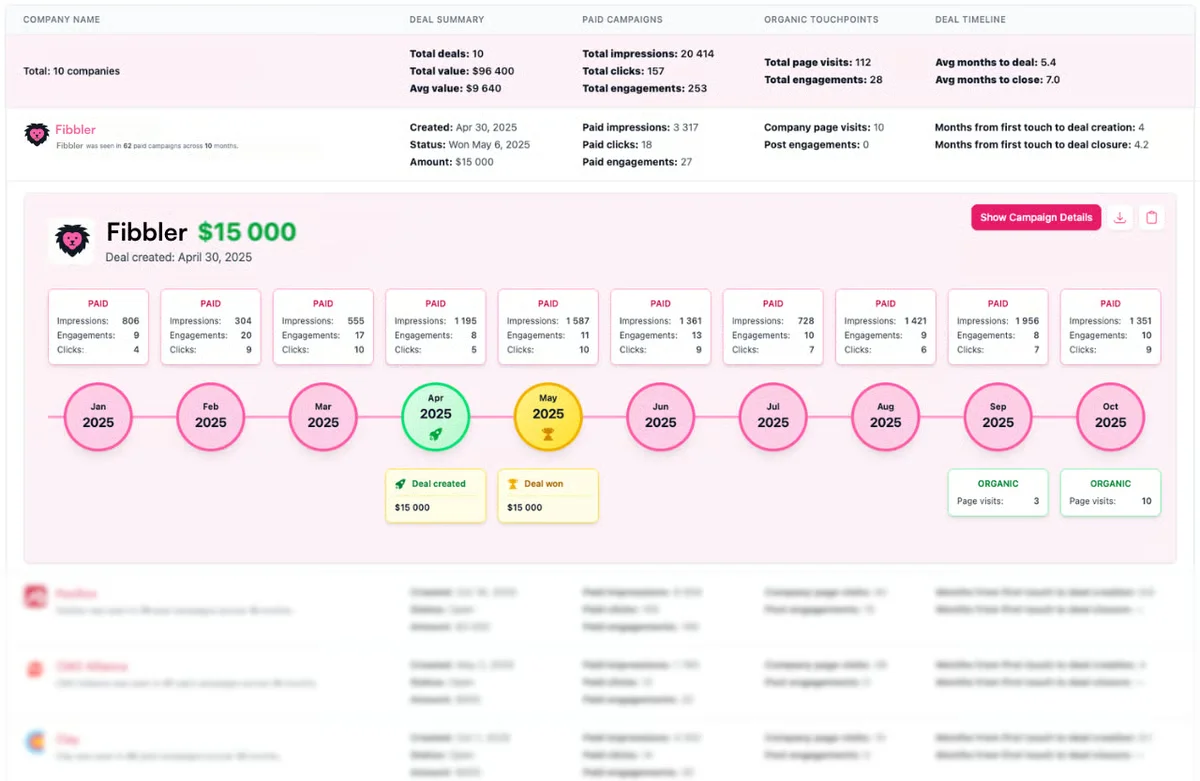
Fibbler is an official LinkedIn Marketing Partner that connects company-level LinkedIn engagement data to your CRM. Instead of guessing which campaigns are involved in pipeline, Fibbler shows which companies saw, clicked or engaged with your ads, and how that lines up with open opportunities and closed revenue. Google Ads and Meta Ads are available as add-ons. It's also SOC 2 Type 1 compliant.
Key Features
- Company-level LinkedIn ad attribution, with organic LinkedIn touches in the same customer journey
- View-through and click-through tracking at the account level
- Direct CRM integrations (HubSpot, Salesforce, Attio, Pipedrive)
- Ad Signals: Fibbler sends the companies engaging with your LinkedIn ads (and Google and Meta ads with the add-ons) straight to where your sales team already works: Slack, Microsoft Teams, your CRM, or Clay, Zapier, n8n and Make. It's simple to set up and runs on its own once it's on
- Campaign-to-revenue mapping inside your CRM
- SOC 2 Type 1 compliant, audited by Sensiba in September 2026, with all customer data hosted in the EU
Where Fibbler Beats Metadata
Metadata runs your ads for you across 12 channels, and its Insights product shows company engagement too. Fibbler doesn't run your campaigns. It does one job: showing which companies see and engage with your LinkedIn, Google and Meta ads and how that lines up with pipeline in your CRM. Pricing is published at $89 to $159 a month, and you can set it up yourself without a demo. If you want AI to build and run campaigns across many channels, Metadata does far more of that than Fibbler.
G2 Rating
4.9 out of 5
Pricing
$89-$159/month with a 30-day free trial. See full pricing.
2. Factors.ai
Best For: Multi-Channel Attribution
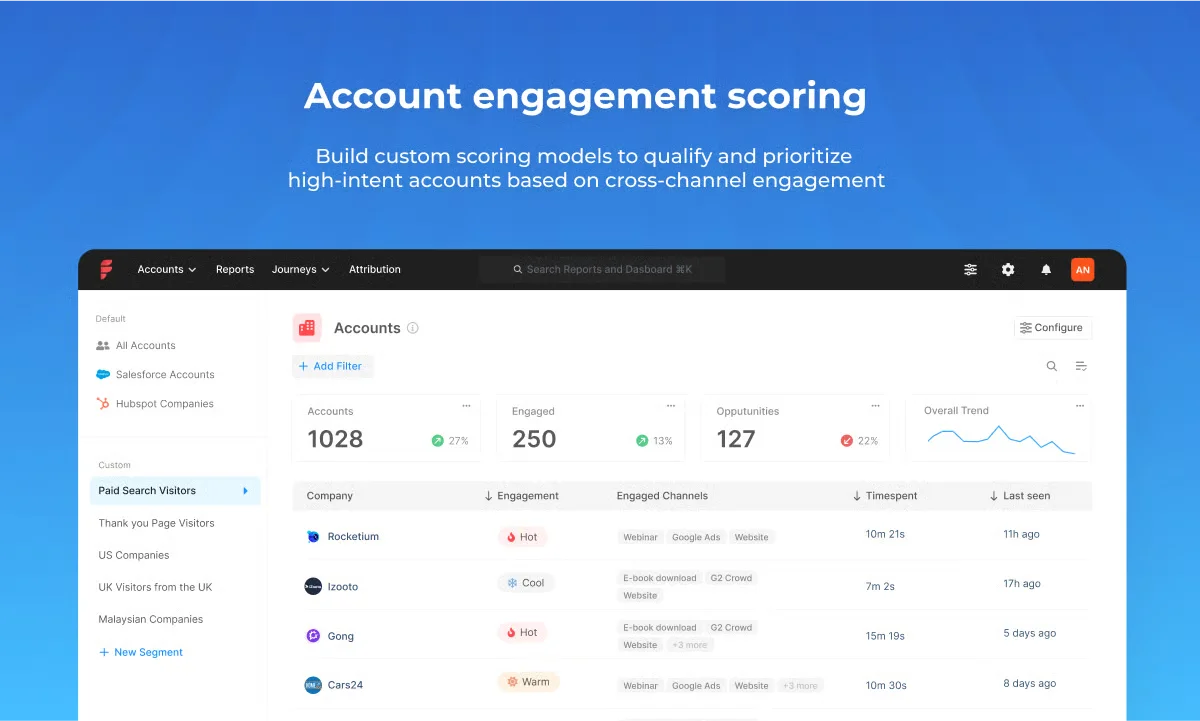
Factors.ai combines account identification, multi-touch attribution, and path analysis into a single platform. It maps anonymous website visitors to accounts and tracks their journey across ads, content, and sales touches.
Key Features
- Account identification and visitor deanonymization
- Multi-touch attribution across LinkedIn, Google, and more
- Customer journey mapping with path analysis
- LinkedIn AdPilot for automated audience syncing
- Transparent event-level data logs
Where Factors.ai Beats Metadata
Factors.ai is built for attribution first, with event-level data logs that let you see how credit is assigned. It also has a free plan and published pricing, so it's easier for mid-market teams to start without a big commitment.
G2 Rating
4.8 out of 5
Pricing
Free Lite plan. Paid plans start at $6,000 a year.
3. HockeyStack
Best For: AI Agents for Revenue Teams
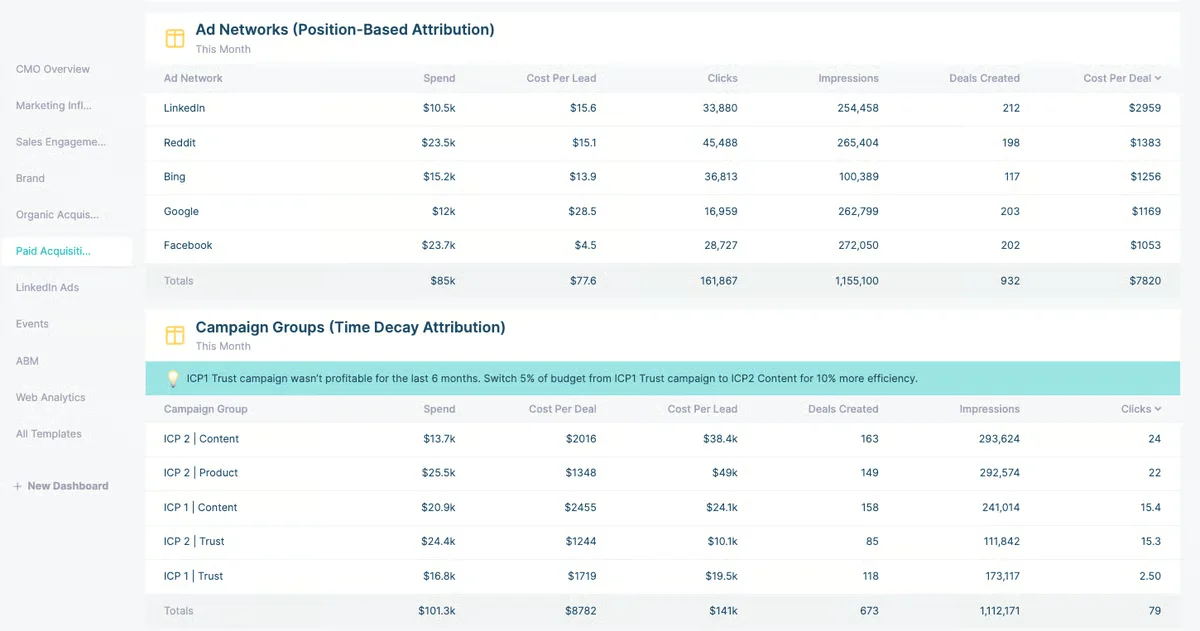
HockeyStack is a GTM intelligence platform that unifies marketing, sales, product usage, and CRM data into a single timeline. It uses AI agents to surface insights and recommend next best actions for revenue teams.
Key Features
- Unified attribution across marketing, sales, and product
- AI-powered GTM agents that answer revenue questions
- Account-level journey stitching
- Predictive scoring and intent signals
- Custom dashboards and reporting
Where HockeyStack Beats Metadata
HockeyStack connects marketing, product usage and CRM data into one timeline. Metadata's focus is running and optimizing your ads, while HockeyStack goes deeper on reporting across every channel and touchpoint, including product usage.
G2 Rating
4.9 out of 5
Pricing
Custom pricing on request. HockeyStack also runs a smaller invite-only pilot for SMB teams.
4. Dreamdata
Best For: Complex B2B Journeys
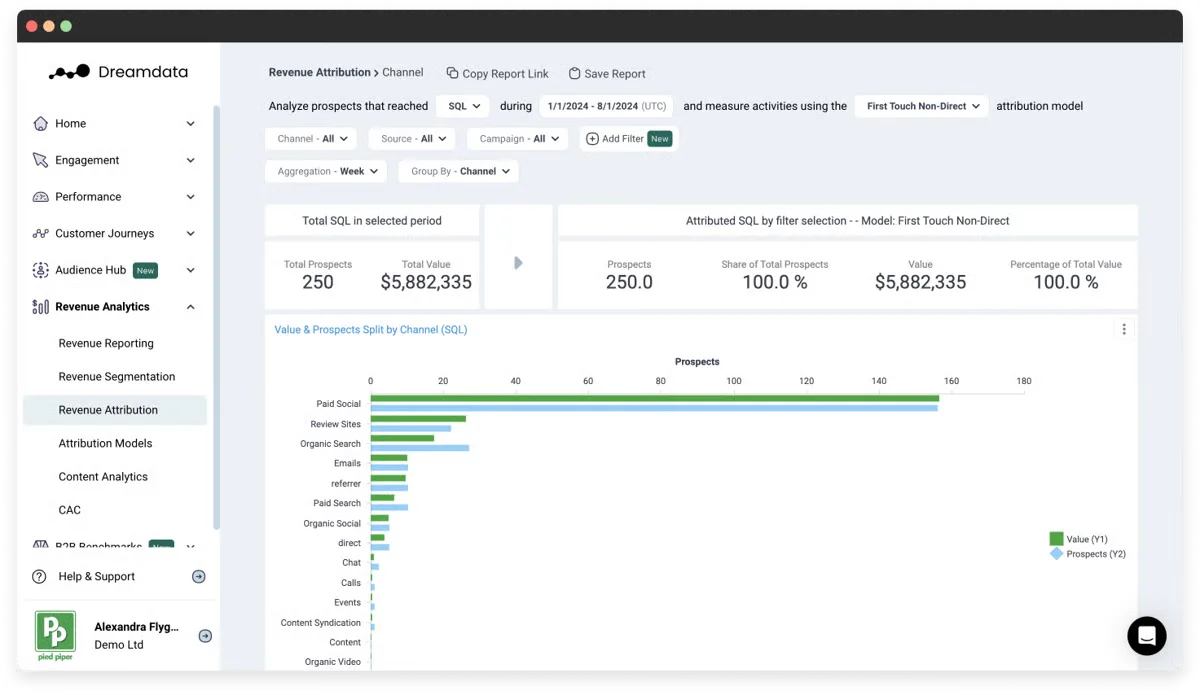
Dreamdata is a B2B revenue attribution platform built to clean, model, and activate go-to-market data. It specializes in mapping long, complex buying journeys with multiple stakeholders and touchpoints across months of engagement.
Key Features
- Automated data cleaning and pipeline modeling
- Multi-touch attribution across the full B2B journey
- Content and channel performance analytics
- Data warehouse-native architecture (BigQuery)
- Account-based engagement scoring
Where Dreamdata Beats Metadata
Dreamdata is strong at cleaning messy CRM data and mapping long-cycle deals with many decision-makers. If your sales cycles span months and involve big buying committees, it goes deeper on multi-touch attribution than Metadata, which is built mainly to run your ads.
G2 Rating
4.7 out of 5
Pricing
Free plan available. Paid plans are priced on request.
5. 6sense
Best For: Enterprise ABM
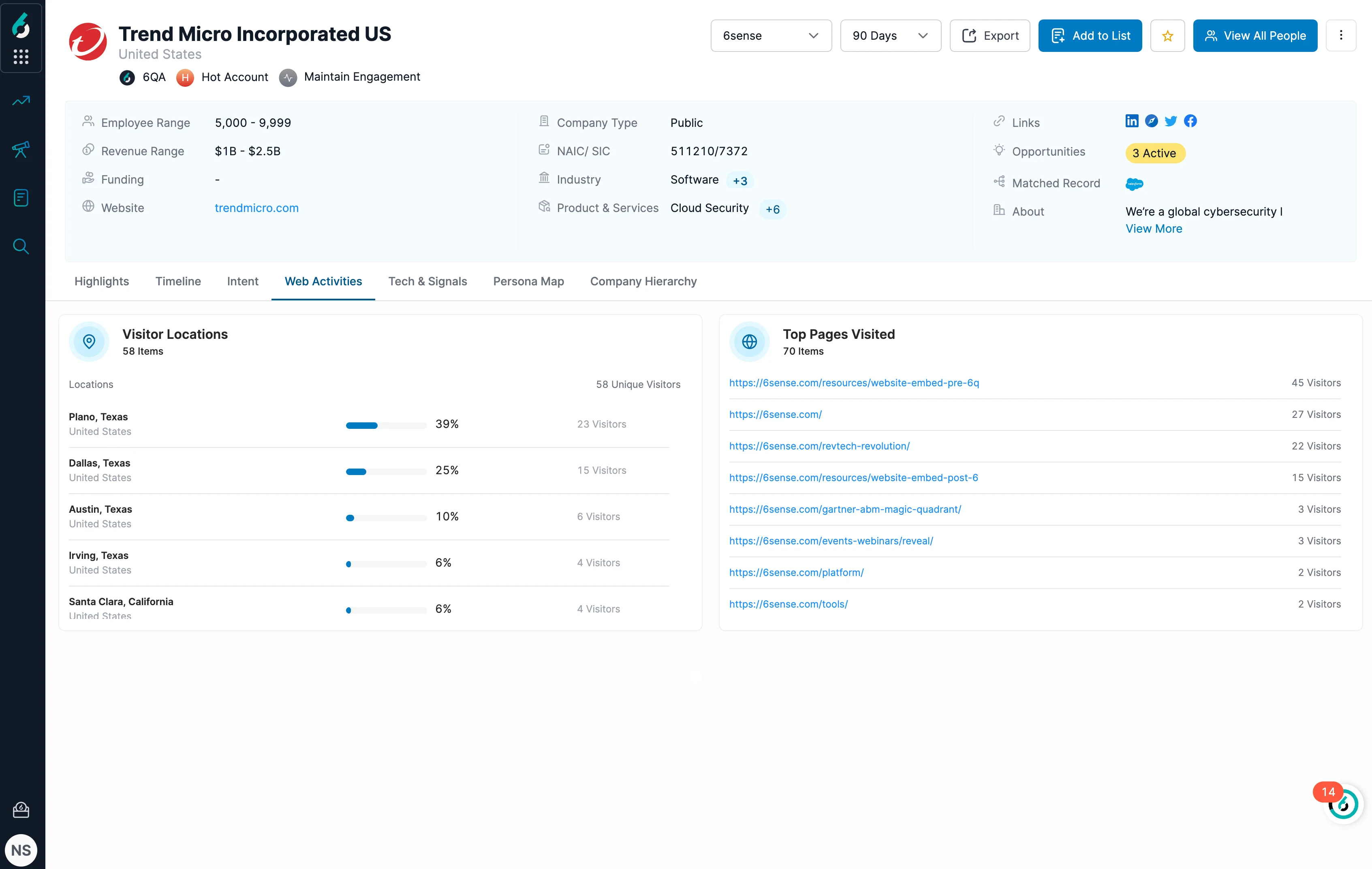
6sense is an enterprise ABM platform that uses AI and predictive analytics to identify accounts showing buying intent before they ever fill out a form. It helps marketing and sales teams prioritize accounts based on where they sit in the buying journey.
Key Features
- Predictive intent data and buying stage identification
- AI-powered account scoring and prioritization
- Dynamic audience building for ad platforms
- Conversational email and sales intelligence
- Enterprise-grade integrations and data security
Where 6sense Beats Metadata
Metadata uses firmographics and intent signals to build audiences, but 6sense is built around predictive intent and buying stages. For enterprise teams that plan all of their ABM around which accounts are in market right now, that depth is the main reason to pick it.
G2 Rating
4.3 out of 5
Pricing
Custom pricing on request
6. Demandbase
Best For: Full-Suite ABM
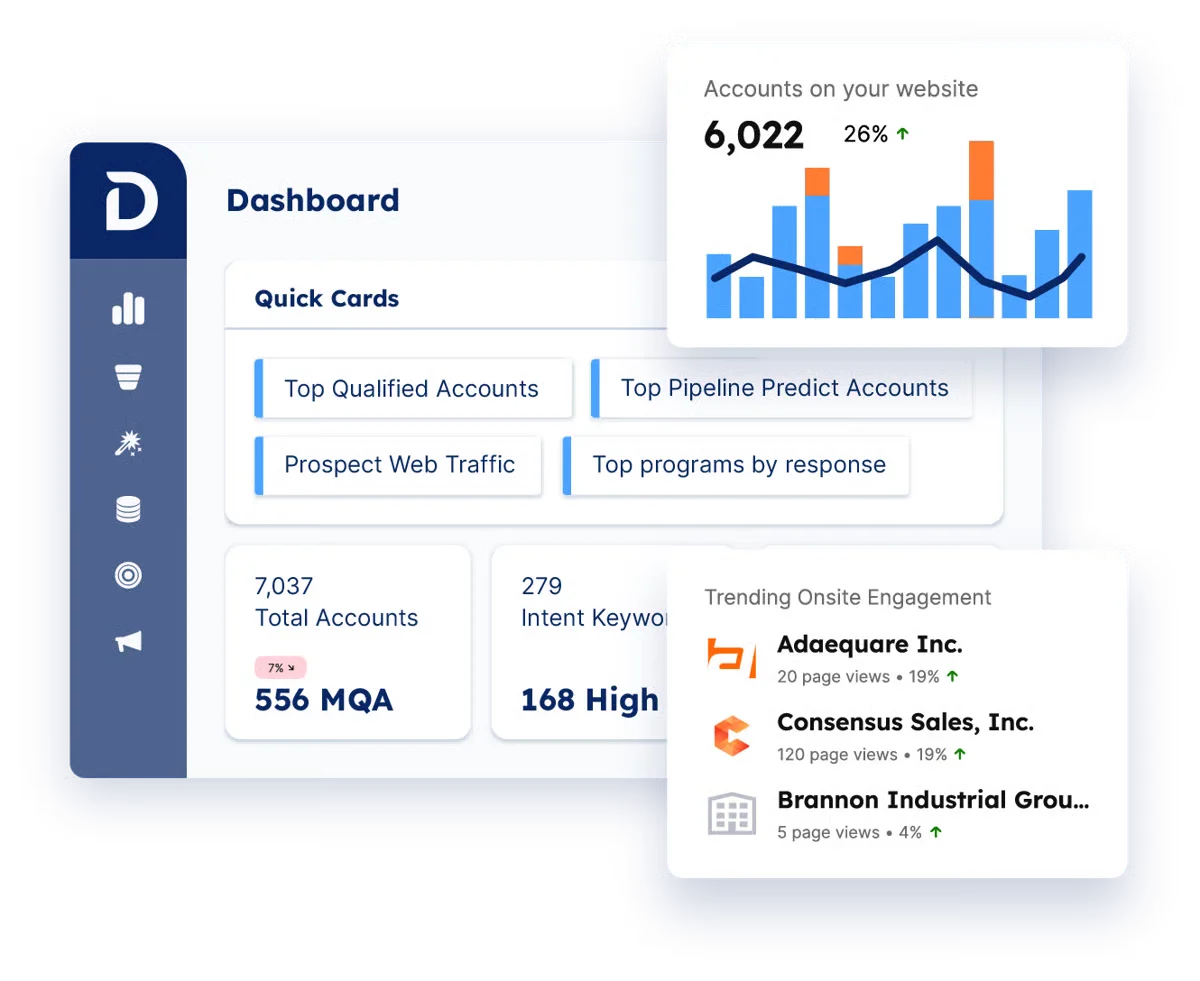
Demandbase is a comprehensive ABM platform that combines account intelligence, advertising, and sales insights into one ecosystem. It serves large global sales organizations that need everything from intent data to display advertising under one roof.
Key Features
- Account identification and intent scoring
- Built-in B2B advertising (display, native, social)
- Sales intelligence with account-level insights
- Personalization engine for web experiences
- Orchestration across marketing and sales workflows
Where Demandbase Beats Metadata
Demandbase covers more of the ABM motion in one place for large global sales orgs. Metadata focuses on running your ads, while Demandbase also covers account intelligence, web personalization and sales enablement, so it suits enterprise teams that want one vendor for all of it.
G2 Rating
4.4 out of 5
Pricing
Custom pricing on request
7. Terminus
Best For: Multi-Channel ABM
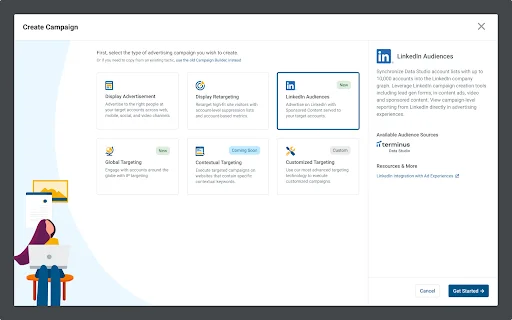
Terminus is a multi-channel ABM platform that focuses on creating "surround sound" experiences for target accounts. It combines display advertising, email signatures, chat, and web personalization to engage accounts across every touchpoint.
Key Features
- Multi-channel advertising (display, LinkedIn, connected TV)
- Email signature marketing for brand awareness
- Chat experiences tailored to target accounts
- Account-level engagement measurement
- CRM and MAP integrations for orchestration
Where Terminus Beats Metadata
Terminus focuses on account "surround sound" across email signatures, chat and web personalization, on top of ads. Metadata is focused on paid media, so if you want to reach target accounts outside of ads too, Terminus covers more of that.
G2 Rating
4.6 out of 5
Pricing
Custom pricing on request
8. Foundry ABM (formerly Triblio)
Best For: Mid-Market ABM
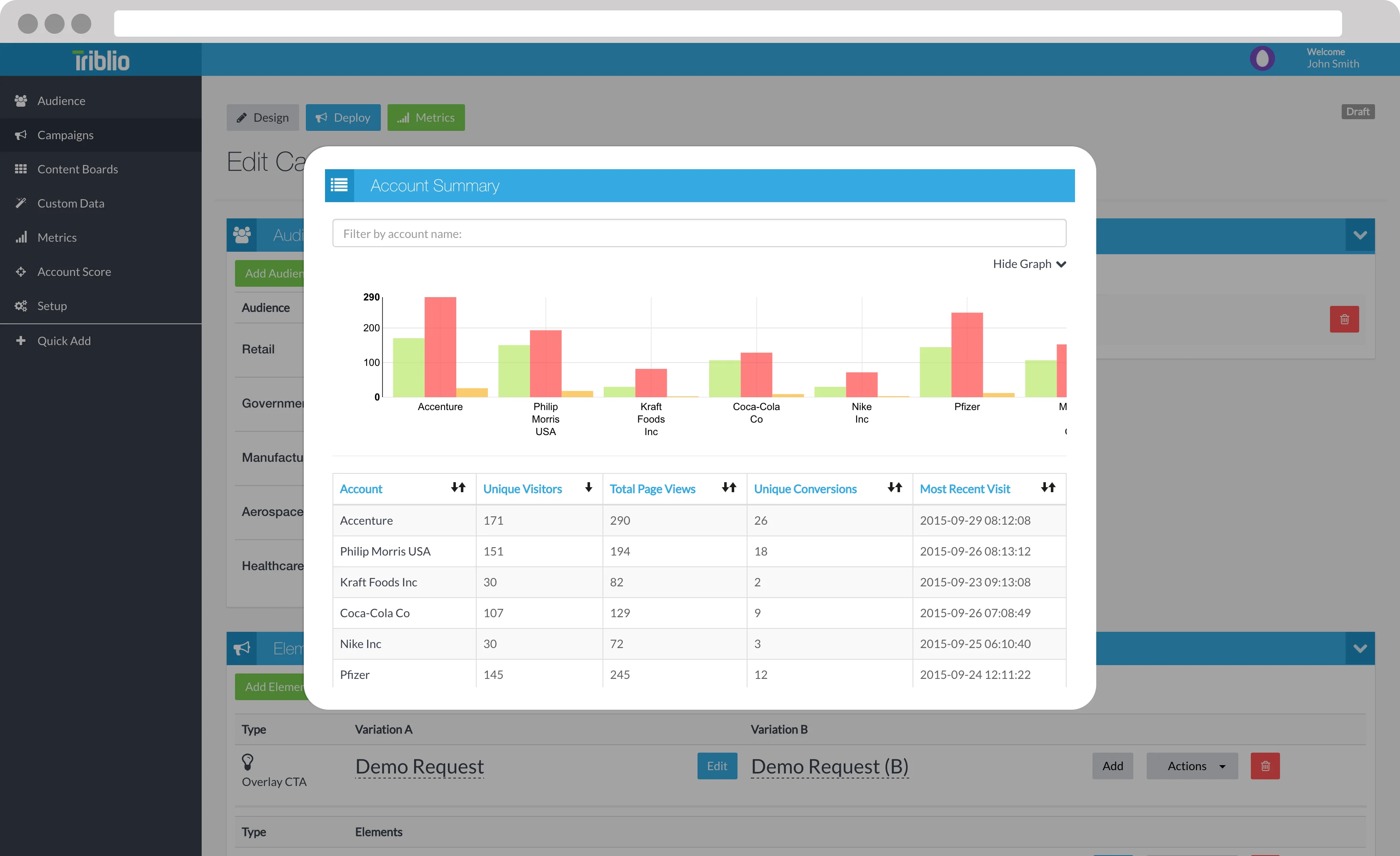
Triblio was bought by IDG (now Foundry) and is sold today as Foundry ABM. It's a mid-market ABM platform that combines account-based advertising with website personalization. It makes it easy for teams to serve targeted ads and dynamically adjust website content based on which accounts are visiting.
Key Features
- Account-based display and programmatic advertising
- Website personalization for target accounts
- Account scoring and intent data
- Sales activation alerts and account insights
- Simple setup designed for mid-market teams
Where Foundry ABM Beats Metadata
Foundry ABM is simpler for teams that want to combine ads with website content that changes for each target account, which isn't Metadata's focus. It's an easier entry point for mid-market teams that want ABM without running a large ad program.
G2 Rating
4.2 out of 5
Pricing
Custom pricing on request
How to Choose the Right Metadata Alternative
The right pick depends on what you actually want to know or do.
- LinkedIn Attribution: Fibbler
- Pipeline Mapping: Factors.ai
- SaaS Growth/LTV: HockeyStack
- Data Warehousing: Dreamdata
- AI that builds and runs your campaigns: Metadata.io is still a strong choice
If your main question is which companies see your LinkedIn ads and how that lines up with your pipeline, Fibbler answers that directly. Plans start at $89 a month with a 30-day free trial, no credit card needed.
Written by

Adam Holmgren
CEO @ Fibbler

Prove paid ads drive pipeline
Fibbler helps you see which companies view or engage with your LinkedIn, Google and Meta Ads, and connect them to pipeline and revenue in your CRM.
Try 30 days for free
Prove paid ads drive pipeline
Fibbler helps you see which companies view or engage with your LinkedIn, Google and Meta Ads, and connect them to pipeline and revenue in your CRM.
Try 30 days for free