

LinkedIn Ads
- LinkedIn Ads Revenue Attribution
- LinkedIn Ads Customer Journeys
- LinkedIn Ads CRM Sync
- LinkedIn Ads Optimization
- LinkedIn Ads Benchmarks

Google Ads

Meta Ads
Cross-Channel
Ad Signals
New



The 15 Best Paid Ad Attribution Tools in 2026
Quick Summary
Running ads on LinkedIn, Google, and Meta usually means three dashboards and no single view of what’s driving revenue. We reviewed 15 paid ad attribution tools, evaluating each on cross-channel attribution, CRM integration, and pricing transparency.
Our top three picks:
| Tool | Best For |
|---|---|
| Fibbler | LinkedIn, Google, and Meta Ads attribution synced to CRM |
| Cometly | True multi-channel server-side tracking across every major ad platform |
| CaliberMind | Enterprise-grade unification across CRM, ad platforms, and channels |
Finding the Best Paid Ad Attribution Tool
Most B2B teams don’t advertise on just one platform. A typical campaign mix spans LinkedIn, Google Ads, and often Meta, each measuring performance differently, reporting results in separate dashboards, and using its own attribution model.
Without a way to bring that data together, it’s difficult to understand how paid campaigns influence pipeline and revenue across the entire customer journey.
Trying to reconcile that manually, usually in spreadsheets, quickly becomes time-consuming and unreliable. Below, we review 15 paid ad attribution tools that help unify campaign data across channels, comparing them on cross-channel capabilities, CRM integrations, ease of implementation, and pricing transparency.
Why Trust Us?
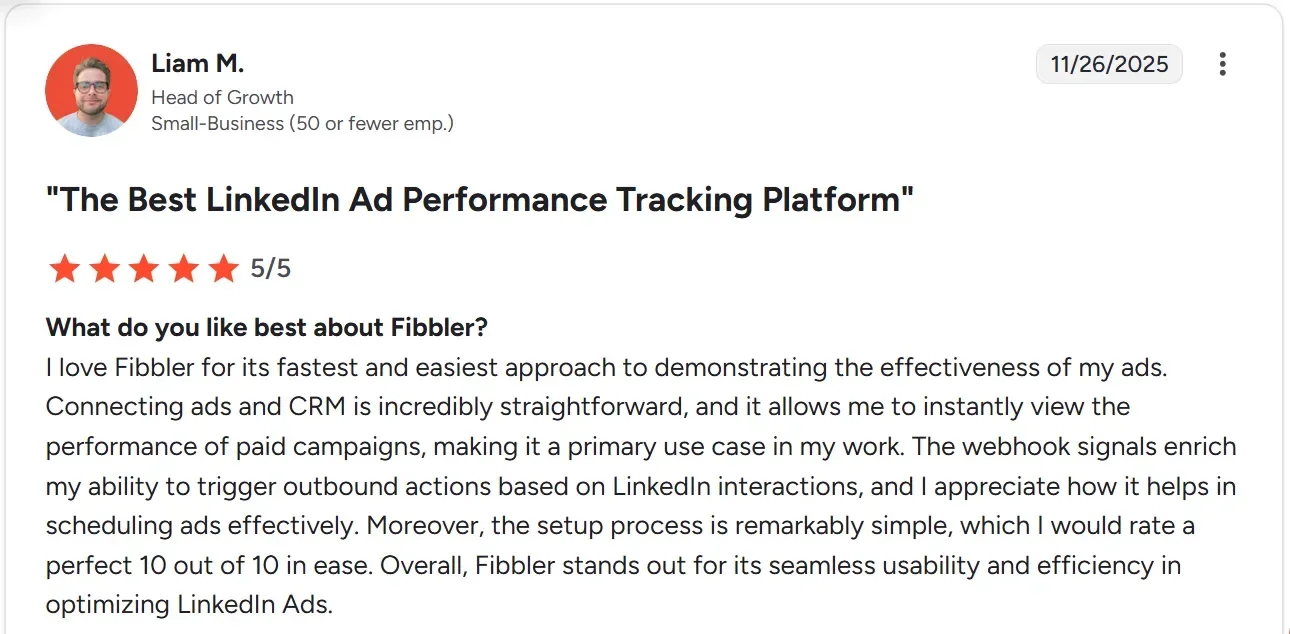
Fibbler is an Official LinkedIn Marketing Partner with direct access to LinkedIn’s Company Intelligence API, giving us firsthand experience with company-level attribution and CRM integrations. We work with B2B marketing teams to connect paid campaigns to pipeline and revenue every day, so we understand the practical strengths, limitations, and tradeoffs of attribution platforms.
That hands-on experience shaped this guide.
The 15 Best Paid Ad Attribution Tools: Full Comparison Table
| Tool | Best For | Integration Type | G2 Rating | Pricing |
|---|---|---|---|---|
| Fibbler | LinkedIn, Google, and Meta Ads attribution | CRM-native | ⭐️4.9/5 | From $89/mo |
| Cometly | True multi-channel server-side tracking | Server-side + CRM | ⭐️4.8/5 | Custom |
| Dreamdata | Multi-touch B2B revenue attribution | CRM + Data warehouse | ⭐️4.7/5 | Custom |
| HockeyStack | Full-funnel GTM analytics | CRM + Product + Warehouse | ⭐️4.5/5 | Custom |
| SegmentStream | ML-driven predictive cross-channel attribution | Marketing stack | ⭐️4.7/5 | Custom |
| CaliberMind | Enterprise multi-CRM, multi-channel unification | CRM + Data warehouse | ⭐️4.5/5 | Custom |
| Rockerbox | Online and offline channel unification | Multi-channel | ⭐️4.6/5 | Custom |
| LeadsRx | Digital and broadcast mixed-media attribution | Online + Offline | ⭐️4.4/5 | Custom |
| Improvado | BI-grade aggregation across every ad platform | Data warehouse | ⭐️4.4/5 | Custom |
| Full Circle Insights | Salesforce-native attribution across channels | Salesforce-native | ⭐️4.0/5 | Custom |
| Factors.ai | Intent-driven account attribution | CRM + Intent | ⭐️4.5/5 | From $199/mo |
| Attribution App | CAC and LTV reporting across ad platforms | Marketing analytics | ⭐️4.5/5 | From $19/mo |
| Adobe Marketo Measure | Enterprise multi-touch attribution across channels | CRM-native | ⭐️4.7/5 | Custom |
| Ruler Analytics | Closed-loop call and form attribution | CRM + Call tracking | ⭐️4.6/5 | From $149/mo |
| Heeet | CRM-native attribution across channels | CRM-native | ⭐️4.8/5 | From $1,490/mo |
1. Fibbler
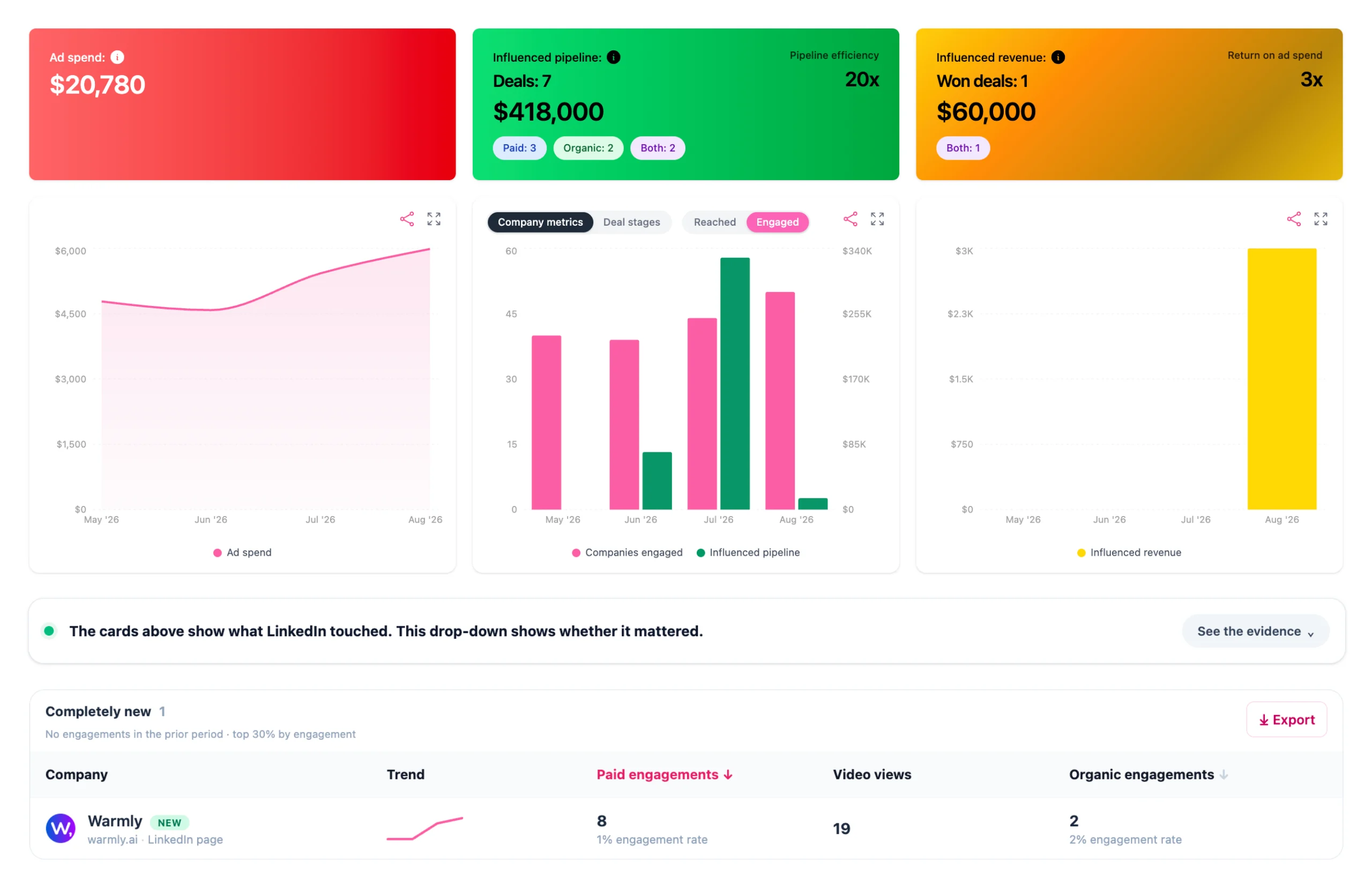
Most B2B teams run paid campaigns across LinkedIn, Google Ads, and sometimes Meta, but not every channel contributes equally to pipeline. Fibbler starts with the two platforms that typically drive the highest-value B2B buying journeys, LinkedIn and Google Ads, and covers Meta Ads too. Instead of comparing separate dashboards, you get one view of how all three channels influence opportunities and revenue. Fibbler is also SOC 2 Type 1 compliant.
Fibbler connects activity from all three to the same company record inside your CRM. Its Google Ads identification add-on reveals the businesses behind anonymous search clicks, the Meta Ads add-on does the same for Facebook and Instagram ad clicks, and LinkedIn engagement is enriched through the Company Intelligence API as an Official LinkedIn Marketing Partner.
The result is a unified customer journey showing how awareness, search intent, pipeline, and revenue connect across your most important B2B paid channels.
Key Features
- Google Ads identification add-on revealing companies behind anonymous search clicks
- Meta Ads add-on revealing companies behind Facebook and Instagram ad clicks
- Company-level LinkedIn, Google, and Meta Ads attribution synced to one CRM record
- Unified customer journey spanning all three paid channels
- Pipeline and revenue attribution tied directly to CRM opportunities
- Company Intelligence API data through Official LinkedIn Marketing Partner status
- CRM sync for HubSpot, Salesforce, Attio, and Pipedrive
- Company-level keyword attribution showing which search terms generate qualified pipeline
- Impression capping to prevent wasted LinkedIn ad spend on overexposed accounts
Pros
- Combines LinkedIn, Google, and Meta Ads company-level attribution in one platform
- Official LinkedIn Marketing Partner with verified Company Intelligence data
- Transparent flat-rate pricing with no enterprise quote process
- Fast implementation with no lengthy enterprise deployment
- Native CRM integrations keep attribution tied directly to pipeline and revenue
- SOC 2 Type 1 compliant, audited by Sensiba in September 2026, with all customer data hosted in the EU
Cons
- Google Ads and Meta Ads are paid add-ons
- Focused on paid digital channels rather than offline attribution
Pricing
Fibbler’s pricing starts at $89/month for growth plan, $129/month for unlimited, and $159/month for agency. The Google Ads and Meta Ads add-ons cost $59/month each. All plans include a 30-day free trial, with a separate 14-day trial available for each add-on.
G2 Rating
⭐️ 4.9/5
See how Fibbler unifies LinkedIn, Google, and Meta Ads attribution.
2. Cometly
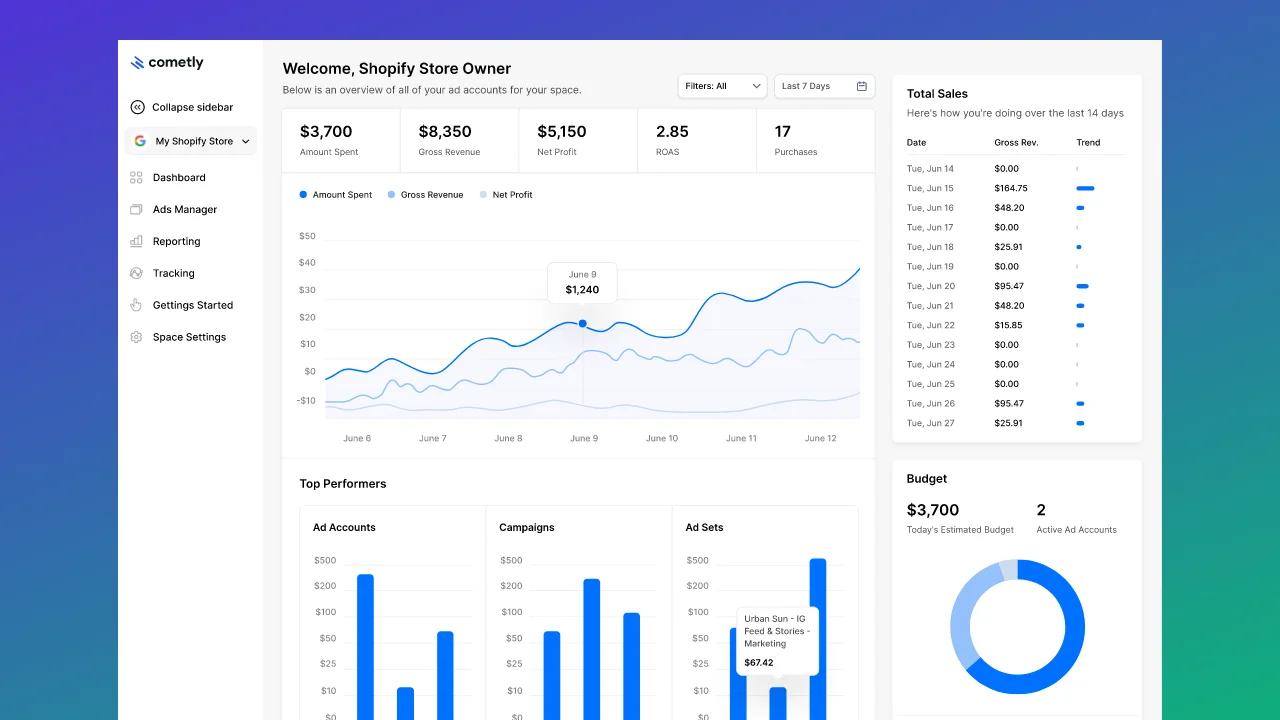
Cometly is built for teams running campaigns across multiple advertising platforms that want cleaner attribution and better optimization, not just better reporting. Instead of relying on browser-based tracking alone, it uses server-side data collection to improve the accuracy of conversions recorded across LinkedIn, Google, Meta, TikTok, and other major ad networks.
Because those enriched conversions are sent back into each platform, Cometly doesn’t just show which campaigns generated revenue. It also helps improve bidding performance over time, making it a practical choice for companies investing heavily across several paid channels.
Key Features
- Server-side tracking across LinkedIn, Google, Meta, and TikTok
- Conversion data synced back into each platform’s bidding algorithm
- Real-time conversion path tracking across the customer journey
- AI-powered recommendations for scaling or cutting campaigns
- CRM sync connecting ad engagement to closed revenue
Pros
- Broadest true multi-channel coverage on this list
- Improves ad performance directly, not just reporting
- Server-side accuracy holds up against browser restrictions
Cons
- Custom pricing based on ad spend, not published
- Best suited to teams with meaningful ad budgets
- AI recommendations need data volume to be reliable
Pricing
Custom pricing based on ad spend volume, requiring a demo for a quote.
G2 Rating
⭐ 4.8/5
3. Dreamdata
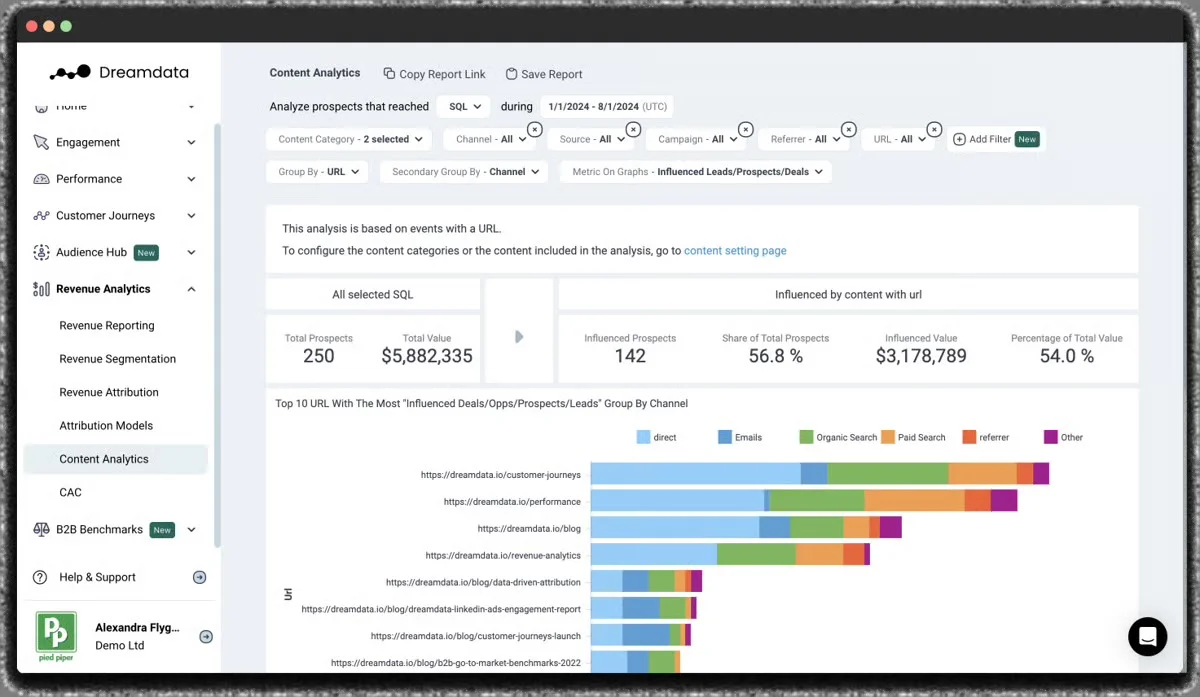
Dreamdata brings together advertising, website, CRM, and sales data into one continuous buyer journey, helping B2B teams understand how multiple paid channels contribute to revenue over time. Rather than crediting a single conversion, it reconstructs the sequence of interactions that moved an account from first touch to closed deal.
This makes it especially valuable for companies running LinkedIn, Google Ads, email, and other campaigns simultaneously, where the real question isn’t which click converted, but how every touchpoint influenced pipeline across a long buying cycle.
Key Features
- Multi-touch attribution combining rule-based and machine learning models
- Full account-level journey reconstruction across every ad channel
- Pipeline and revenue reporting tied to CRM deal records
- Anonymous visitor stitching connecting traffic to known accounts
- Data warehouse sync for advanced BI reporting
Pros
- Reconstructs complex B2B buying journeys across multiple channels
- Transparent attribution methodology without relying on black-box scoring
- Strong CRM integrations for pipeline and revenue reporting
Cons
- Pricing is quote-based and varies by deployment size
- Requires implementation time before delivering full value
- May be more advanced than smaller marketing teams require
Pricing
Dreamdata pricing is custom, with entry-level plans estimated at $750 to $999 per month.
G2 Rating
⭐ 4.7/5
4. HockeyStack
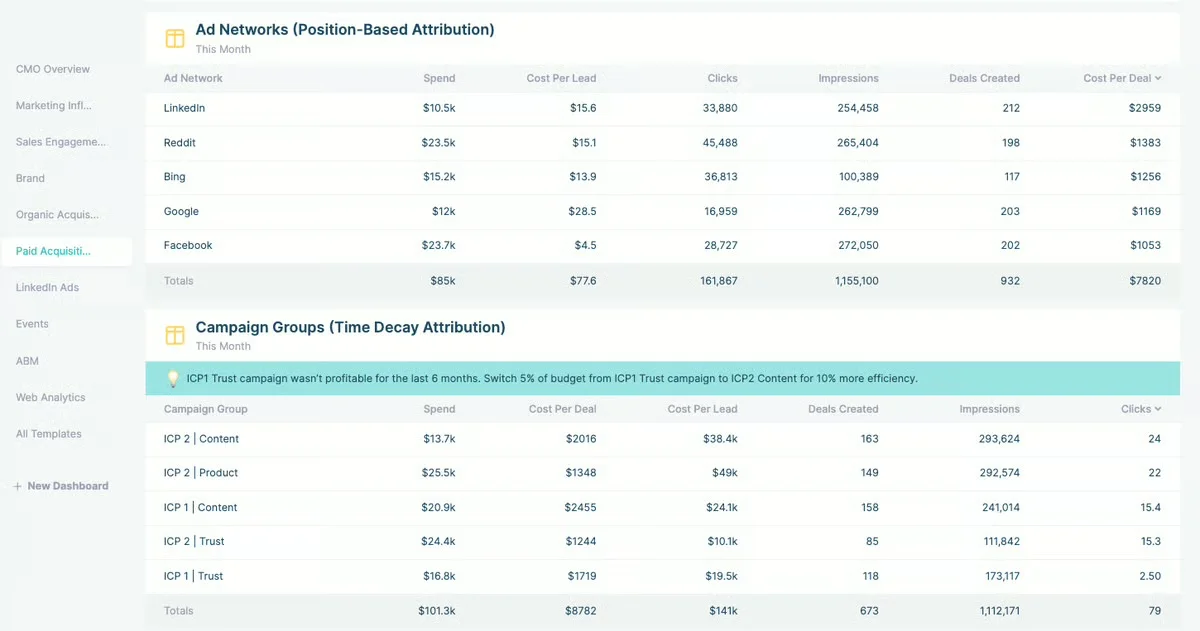
HockeyStack combines advertising data, website behavior, CRM activity, and product usage into a unified GTM analytics platform. Instead of switching between separate reports for Google Ads, LinkedIn, and sales performance, teams can trace how every paid campaign contributed to pipeline using a single account-level timeline.
Its standout feature is Odin AI, which lets users ask plain-English questions about marketing performance instead of manually building reports. That makes it particularly attractive for RevOps and marketing leaders who need quick answers without constantly relying on analysts.
Key Features
- Cookieless, privacy-safe tracking across every major ad channel
- Odin AI analyst for natural-language performance queries
- Account-level journey mapping across multiple buying stakeholders
- Ad spend mapped directly to pipeline stage progression
- Unified GTM data combining marketing, sales, and product signals
Pros
- Cookieless tracking designed for evolving privacy standards
- AI-powered reporting significantly reduces manual analysis
- Strong visibility across multi-channel account journeys
Cons
- Enterprise pricing creates a barrier for growing teams
- Annual contract required with no monthly payment option
- No published pricing, so budgeting needs a sales call
Pricing
While pricing is custom, third-party estimates indicate plans start at approximately $1,399 per month.
G2 Rating
⭐ 4.5/5
5. SegmentStream
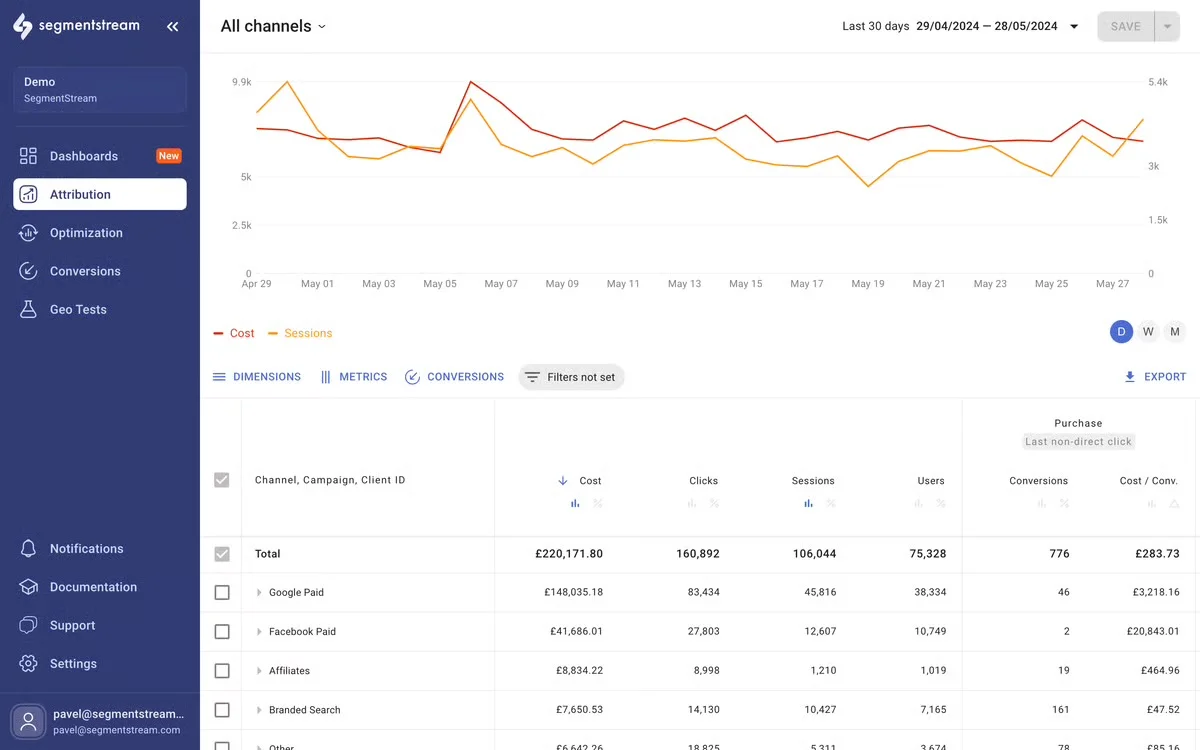
SegmentStream approaches attribution differently from traditional platforms by using machine learning to estimate how each marketing channel contributed to a conversion. Instead of assigning credit using fixed rules, it continuously models customer behavior across paid and organic touchpoints to produce a more balanced picture of marketing performance.
That makes it a strong option for organizations running sizeable budgets across multiple platforms and looking to improve media allocation. Beyond reporting, the platform also recommends where additional spend is likely to generate the greatest incremental return.
Key Features
- ML-driven predictive attribution replacing fixed rule-based models
- First-party data collection compatible with privacy regulations
- Budget optimization recommendations spanning the full channel mix
- Cross-channel measurement including dark social and offline
- Transparent methodology avoiding black-box scoring
Pros
- Predictive modeling provides more realistic cross-channel attribution
- Budget recommendations help improve future campaign performance
- Privacy-first architecture designed for a cookieless environment
Cons
- High minimum ad spend requirement limits eligible teams
- Pricing opacity makes budget planning difficult upfront
- Implementation needs data engineering resources most teams lack
Pricing
Custom enterprise pricing. Third-party data suggests a minimum monthly ad spend of approximately $50,000 to qualify.
G2 Rating
⭐ 4.7/5
6. CaliberMind
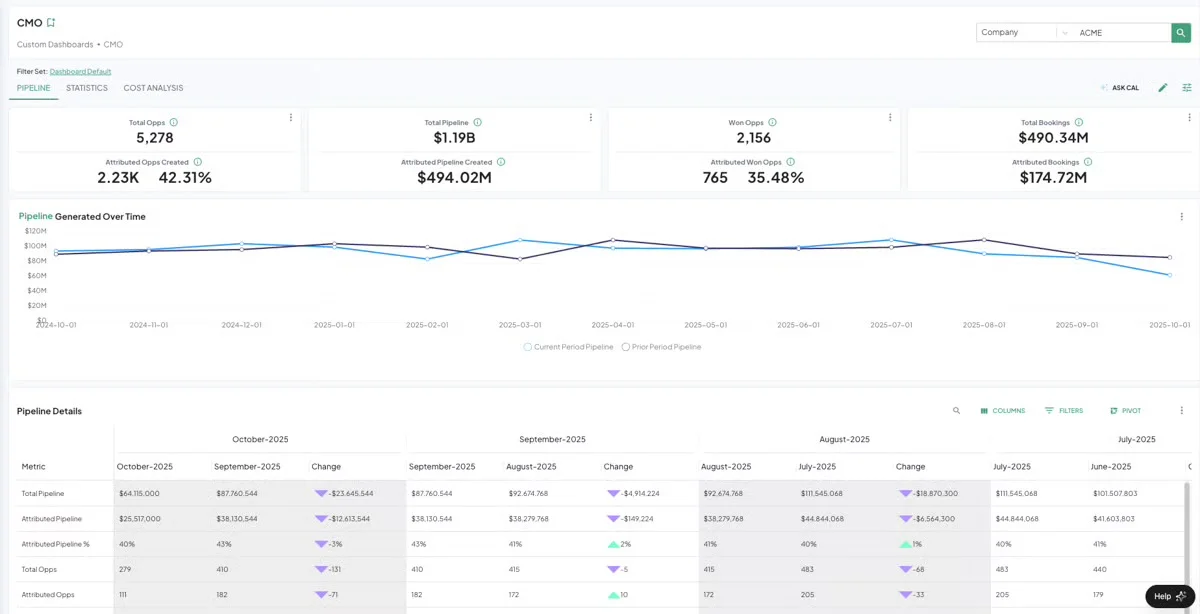
CaliberMind is designed for enterprise marketing and RevOps teams managing data across multiple advertising platforms, CRMs, and marketing automation systems. Rather than focusing only on attribution, it creates a unified operating layer that connects fragmented customer data into a consistent account view.
Its strength lies in handling environments where several business units, regions, or brands all contribute marketing data. For organizations that have outgrown simpler attribution software, CaliberMind provides the flexibility needed to build highly customized reporting and measurement frameworks.
Key Features
- Funnel analytics, attribution, and ABM scoring across every channel
- Custom models tailored to specific GTM motions and stages
- Buyer journey reconstruction spanning marketing and sales touchpoints
- AI-assisted insights via built-in analyst tooling
- Enterprise-grade unification across multiple ad platforms
Pros
- Handles complex multi-source marketing data with minimal duplication
- Highly configurable attribution models for enterprise GTM teams
- Combines attribution with robust ABM and sales intelligence capabilities
Cons
- Custom pricing with limited public transparency
- Better suited to enterprise deployments than lean teams
- Implementation requires significant data engineering investment
Pricing
Custom enterprise pricing. Procurement data suggests annual contracts commonly range from $30,000 to over $50,000, depending on deployment size.
G2 Rating
⭐ 4.5/5
7. Rockerbox
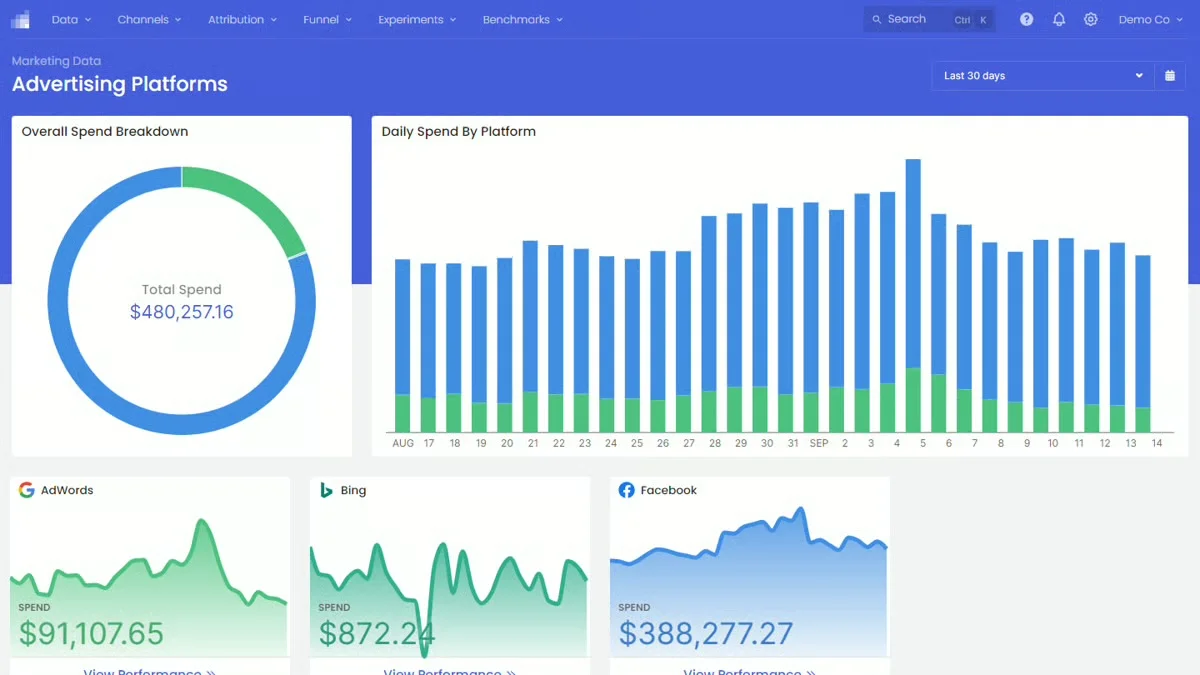
Rockerbox helps brands understand how every marketing channel contributes to revenue, whether that spend happens online, offline, or somewhere in between. Alongside traditional multi-touch attribution, it supports media mix modeling and incrementality testing, giving marketers multiple ways to evaluate campaign effectiveness.
The platform is particularly well suited to organizations investing across digital advertising, connected TV, podcasts, and other brand-building channels where simple last-click attribution significantly understates marketing impact.
Key Features
- Multi-touch attribution unifying paid, organic, and offline channels
- Media mix modeling and incrementality testing built in
- Deduplicated conversion tracking across overlapping ad platforms
- OTT and CTV channel tracking alongside standard digital ads
- Data warehouse integration for advanced cross-channel analysis
Pros
- Broad channel coverage extending beyond digital advertising
- Incrementality testing helps separate causation from correlation
- Strong option for sophisticated enterprise measurement programs
Cons
- Enterprise-oriented pricing and setup, less suited to lean teams
- Incrementality testing requires meaningful budget and data volume
- Overkill for teams focused narrowly on LinkedIn and Google
Pricing
Pricing is customized based on measured advertising spend and implementation requirements.
G2 Rating
⭐ 4.6/5
8. LeadsRx
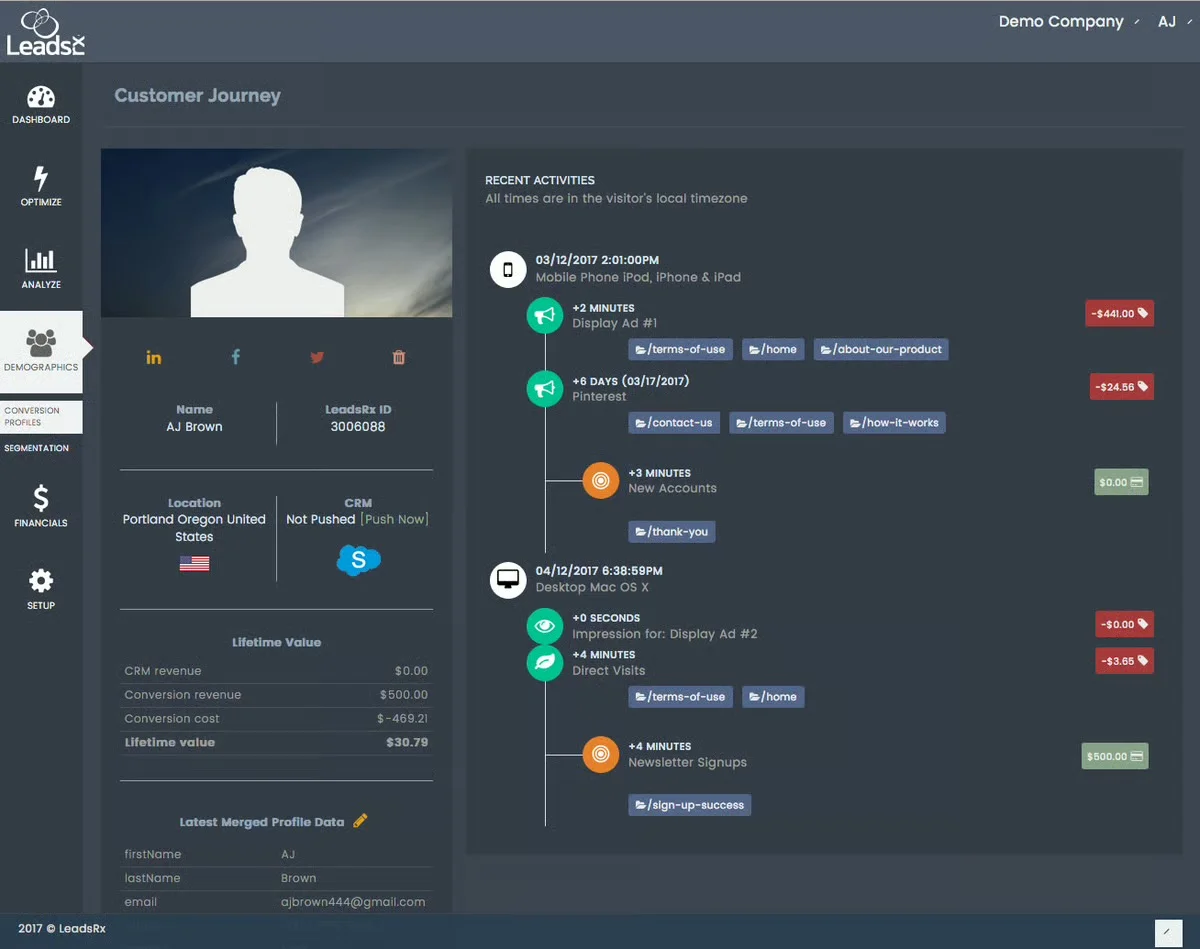
LeadsRx is one of the few attribution platforms designed to measure both digital and traditional advertising within the same reporting framework. It combines Google, LinkedIn, Meta, display, TV, radio, podcasts, and other media into a unified customer journey, helping marketers understand how different channels work together instead of competing for credit.
That broader perspective makes it especially valuable for companies investing beyond digital advertising. Rather than evaluating each campaign in isolation, LeadsRx helps quantify how offline and online media collectively influence conversions and revenue.
Key Features
- Multi-touch attribution spanning digital, offline, and broadcast channels
- Universal pixel for unified visitor tracking across sessions
- Radio, TV, and podcast attribution alongside digital ads
- Marketing mix modeling support for broader budget decisions
- Strong offline and cross-device identity stitching
Pros
- Connects broadcast and digital campaigns within one attribution model
- Vendor-agnostic approach works alongside existing marketing platforms
- Well suited to brands combining traditional and digital advertising
Cons
- Offline attribution depth is unnecessary for digital-only advertisers
- Custom pricing requires a sales conversation for a quote
- Less specialized for account-level B2B attribution specifically
Pricing
Custom pricing requiring a quote from the sales team.
G2 Rating
⭐ 4.4/5
9. Improvado
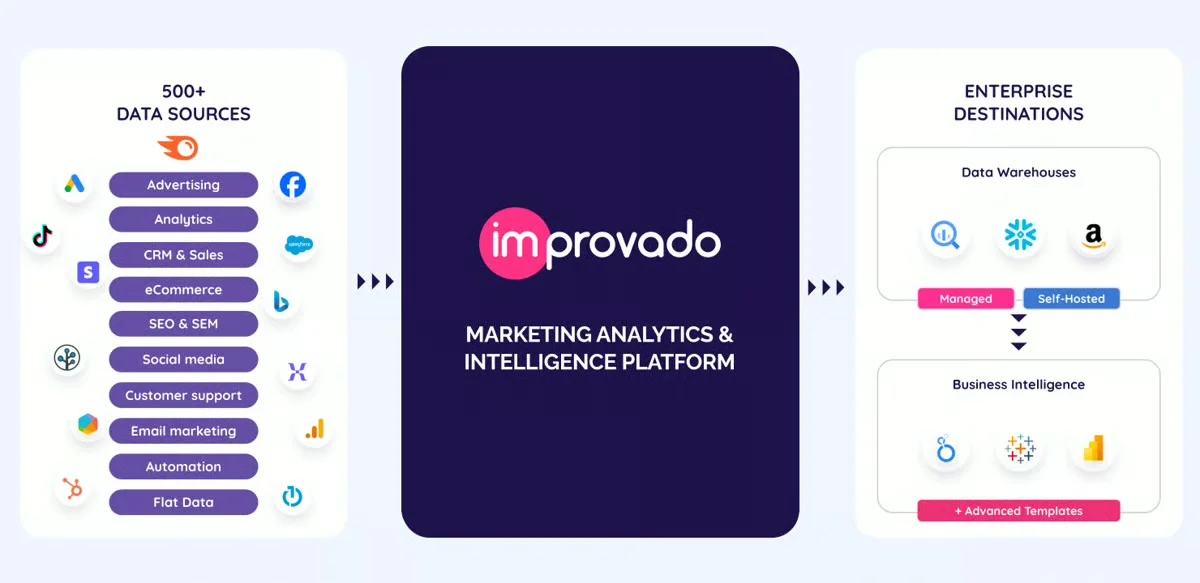
Improvado is less of a traditional attribution platform and more of a marketing data infrastructure solution. It centralizes information from hundreds of advertising platforms, CRMs, analytics tools, and databases, giving organizations a single source of truth that can support custom attribution models and executive reporting.
For businesses with mature analytics teams, Improvado provides the flexibility to build highly tailored dashboards instead of relying on predefined attribution reports. Its strength lies in aggregating large volumes of marketing data at enterprise scale.
Key Features
- Pre-built connectors pulling data from every major ad platform
- ETL and data transformation combining marketing and sales data
- Customizable dashboards for cross-channel campaign reporting
- API access for custom attribution modeling on unified data
- AI-driven automation for recurring analytics workflows
Pros
- Extensive connector library covering virtually every major marketing platform
- Scales well for enterprise reporting and agency environments
- Supports custom attribution strategies through centralized data
Cons
- Requires more setup investment than purpose-built attribution tools
- Volume-based pricing makes upfront budgeting difficult
- Best suited to teams with existing analytics maturity
Pricing
Volume-based custom pricing tailored to data sources and usage, with no published starting figure.
G2 Rating
⭐ 4.4/5
10. Full Circle Insights
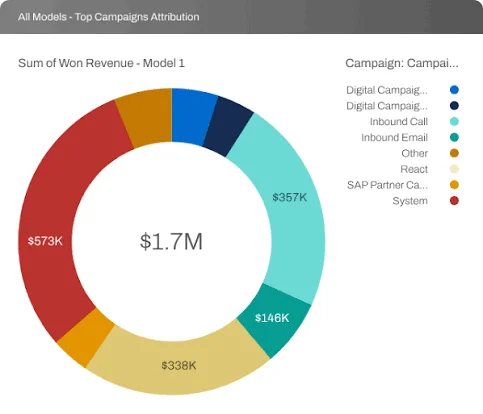
Full Circle Insights was purpose-built for Salesforce users who want attribution, funnel reporting, and campaign performance to live entirely inside their CRM. Developed by former Salesforce executives, it connects paid advertising activity directly to Salesforce opportunities without requiring teams to rely on a separate reporting platform.
Because everything remains inside Salesforce, marketing and sales teams work from the same data when evaluating campaign performance. That native architecture makes it particularly attractive to enterprises already committed to the Salesforce ecosystem.
Key Features
- Salesforce-native architecture built by former Salesforce team members
- Multiple attribution models configurable within Salesforce directly
- Funnel measurement connecting every ad channel to revenue stages
- Marketing and sales alignment reporting inside existing views
- No separate dashboard required for attribution reporting
Pros
- Deep Salesforce-native attribution with minimal data duplication
- Built specifically for organizations standardized on Salesforce
- Eliminates the need for separate attribution dashboards
Cons
- Only viable for teams fully committed to Salesforce
- Custom pricing with contracts often reaching five figures
- Limited value for teams running other CRMs
Pricing
Custom pricing. Third-party procurement data suggests mid-market contracts commonly range from $30,000 to $90,000 annually, while larger enterprise deployments can exceed $120,000.
G2 Rating
⭐ 4.0/5
11. Factors.ai
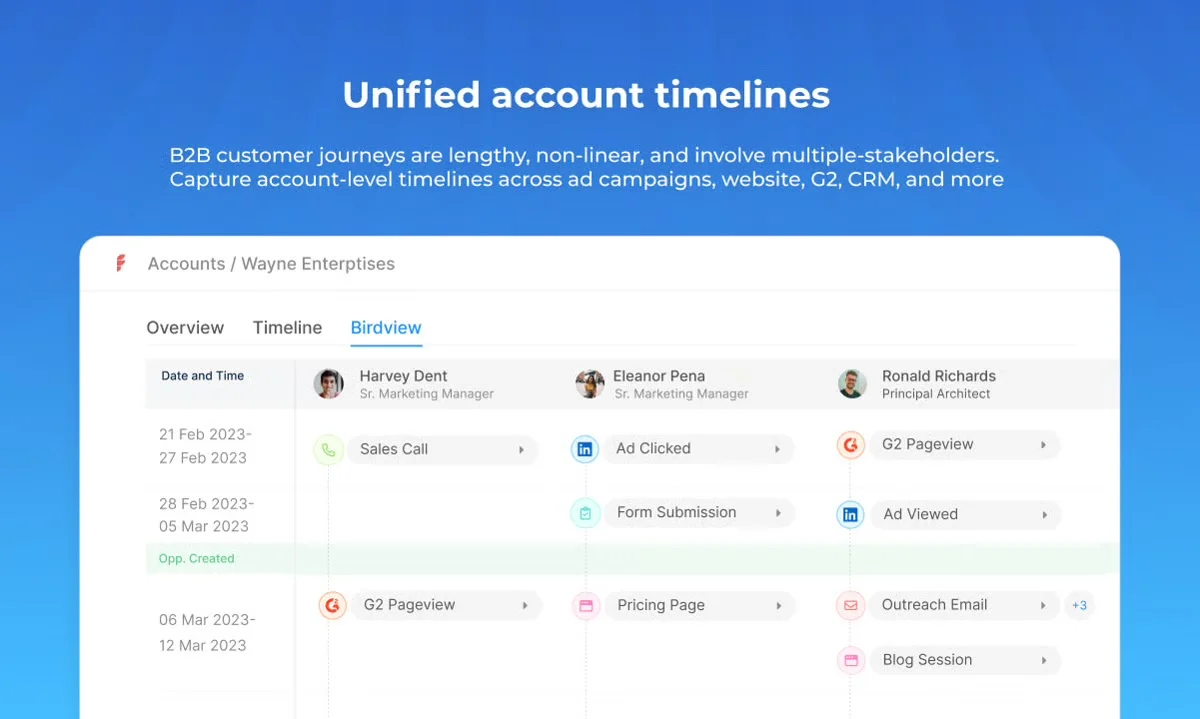
Factors.ai combines account identification, intent data, and multi-touch attribution to help B2B teams understand which companies are engaging across their paid campaigns. Rather than measuring individual clicks alone, it surfaces the accounts behind that activity and shows how marketing efforts contribute to pipeline over time.
The platform is particularly useful for businesses running campaigns across LinkedIn and Google while prioritizing account-based marketing. Although its entry-level plans provide attribution and insights, many of the audience activation and advertising features that larger teams want are reserved for the higher-priced tiers.
Key Features
- Anonymous company identification across website and ad traffic
- Intent signals combining first, second, and third-party data
- Multi-touch attribution across marketing touchpoints
- LinkedIn and Google audience sync at higher tiers
- Custom account scoring to prioritize in-market companies
Pros
- Published tier pricing, unlike most enterprise competitors
- Strong intent-signal layer beyond basic click attribution
- Startup-friendly discounts available for early-stage teams
Cons
- Entry tier excludes the ad-activation features most buyers need
- Full cross-channel activation requires the Enterprise tier
- Some third-party pricing information found online is outdated
Pricing
Lite starts at $199 per month, Basic at $6,000 per year, Growth at $20,000 per year, and Enterprise at $30,000 per year and up.
G2 Rating
⭐ 4.5/5
12. Attribution App
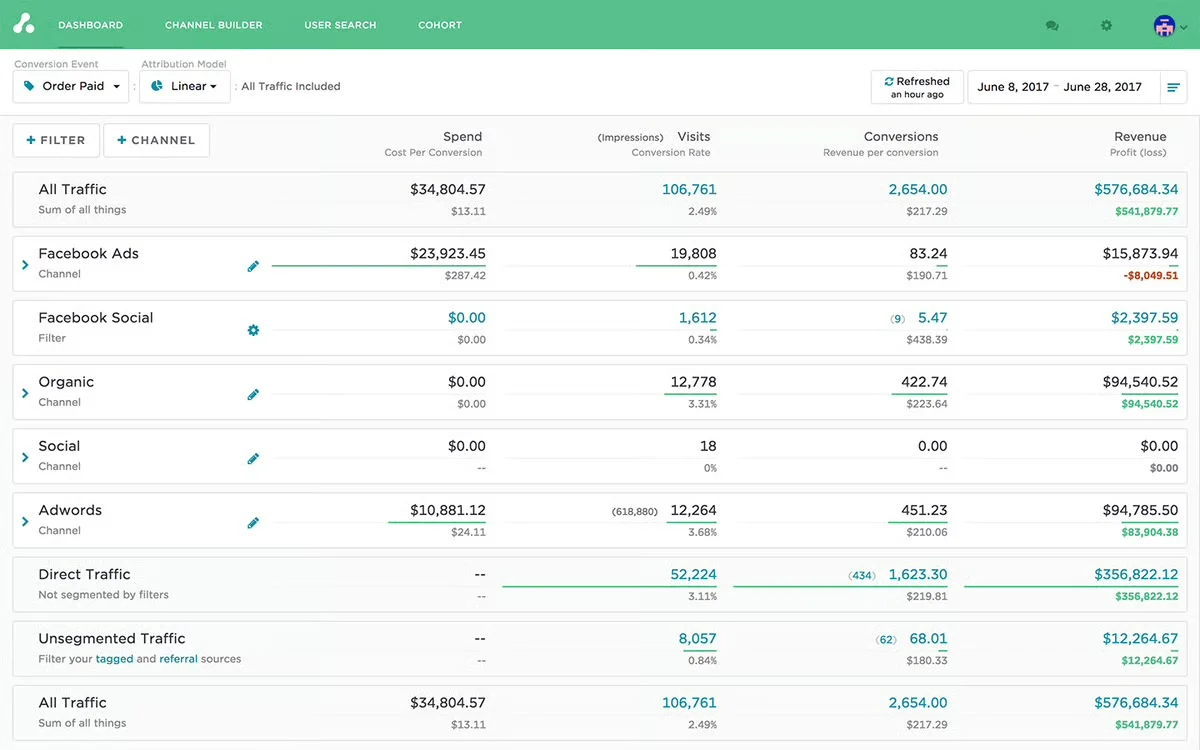
Attribution App focuses on connecting marketing spend to financial outcomes instead of simply reporting conversions. By combining advertising data with CRM and revenue information, it helps teams understand customer acquisition costs, lifetime value, and the true return generated by every paid channel.
Its reporting is designed for marketing leaders and finance teams that need clear business metrics without building complicated attribution models from scratch. That emphasis on profitability makes it a practical option for companies measuring performance beyond campaign-level engagement.
Key Features
- Multi-touch attribution overlaid directly on CRM deal records
- CAC, payback period, and LTV to CAC reporting
- Channel and campaign-level ROI insights across ad platforms
- Real-time dashboards with minimal maintenance overhead
- Integrations with Stripe, Segment, HubSpot, and Salesforce
Pros
- Clean financial reporting aligned with executive-level metrics
- Fast setup with simple ongoing maintenance requirements
- Accessible pricing compared to enterprise attribution alternatives
Cons
- Less suited for complex ABM or multi-stakeholder journeys
- Limited account-level depth versus dedicated B2B platforms
- Advanced reporting features require higher-tier plans
Pricing
Starts at $19 per month for the Shopify plan and $399 per month for the Pro plan. Custom quotes available for Enterprise.
G2 Rating
⭐ 4.5/5
13. Adobe Marketo Measure (Bizible)
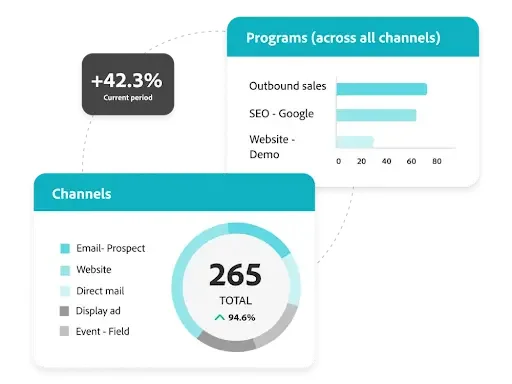
Adobe Marketo Measure has long been one of the most established enterprise attribution platforms, helping large B2B organizations connect paid, organic, email, events, and offline interactions into a unified reporting model. Its strength comes from deep Salesforce integration and highly configurable attribution for complex buying journeys.
Although newer competitors have entered the market, Marketo Measure remains a common choice for enterprises already invested in Adobe’s marketing ecosystem. The trade-off is a significantly larger implementation project and a price point that places it beyond the reach of most growing businesses.
Key Features
- Multi-touch models spanning paid, organic, email, and offline channels
- Custom attribution rules mapped to Salesforce Campaign structures
- Account-level journey tracking across full buying committees
- Boomerang stage tracking for recycled enterprise opportunities
- Deep CRM reporting without external dashboard tools
Pros
- Longest track record of any multi-channel platform here
- Extensive documentation and enterprise implementation support
- Strong fit for teams with dedicated RevOps admins
Cons
- Annual contracts typically range from $50,000 to over $150,000
- Implementation complexity requires months and technical resources
- Development has slowed noticeably since the Adobe acquisition
Pricing
Custom enterprise pricing. Third-party data suggests annual contracts ranging from $50,000 to over $150,000.
G2 Rating
⭐ 4.7/5
14. Ruler Analytics
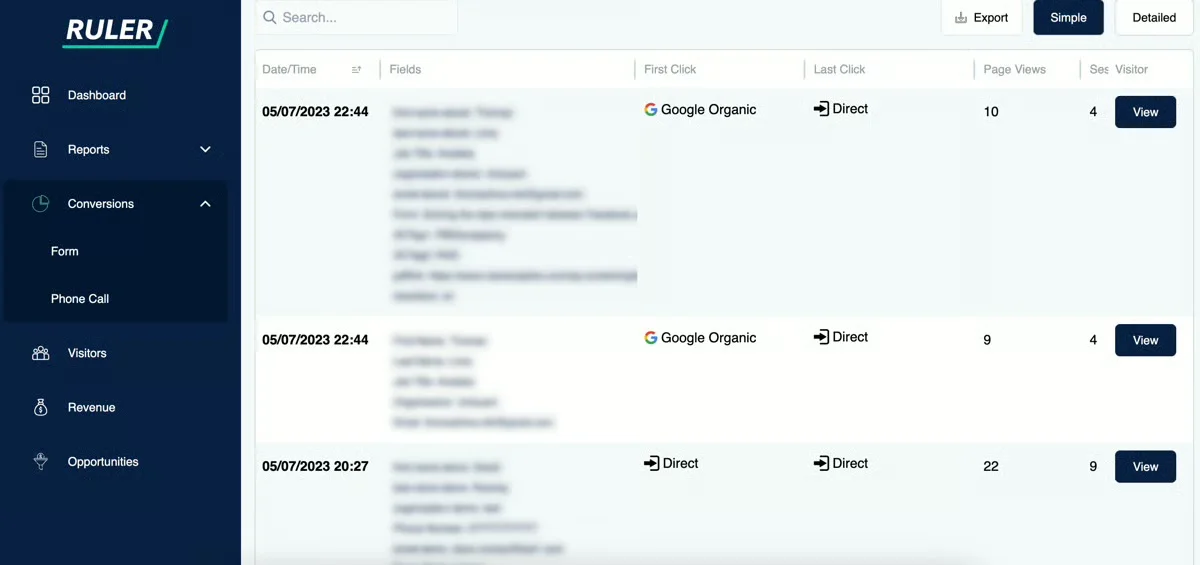
Ruler Analytics specializes in closing the gap between advertising activity and revenue by tracking the individual visitor from their first interaction through calls, forms, live chat, and eventually into the CRM. Instead of relying solely on platform-reported conversions, it attributes revenue back to the marketing source that generated the customer.
Its combination of visitor-level tracking and call attribution makes it especially valuable for businesses where phone enquiries play an important role in the buying process. The platform keeps implementation relatively straightforward while still providing meaningful multi-touch reporting.
Key Features
- Visitor-level tracking from first ad click to closed revenue
- Call tracking synced to the paid channel that drove it
- Multi-touch attribution models including first, last, and linear
- UTM-level source clarity across every ad platform
- Direct sync to CRM contact and deal records
Pros
- Strongest call attribution coverage of any tool here
- Simple setup that doesn’t require a data team
- Predictable tiered pricing without enterprise lock-in
Cons
- Less suited to purely account-based, no-call B2B motions
- Limited anonymous visitor identification versus intent-first tools
- Not built for warehouse-native or BI-heavy reporting
Pricing
Starts at $149 per month for small businesses. Medium and large business plans range from $584-$999 per month.
G2 Rating
⭐ 4.6/5
15. Heeet
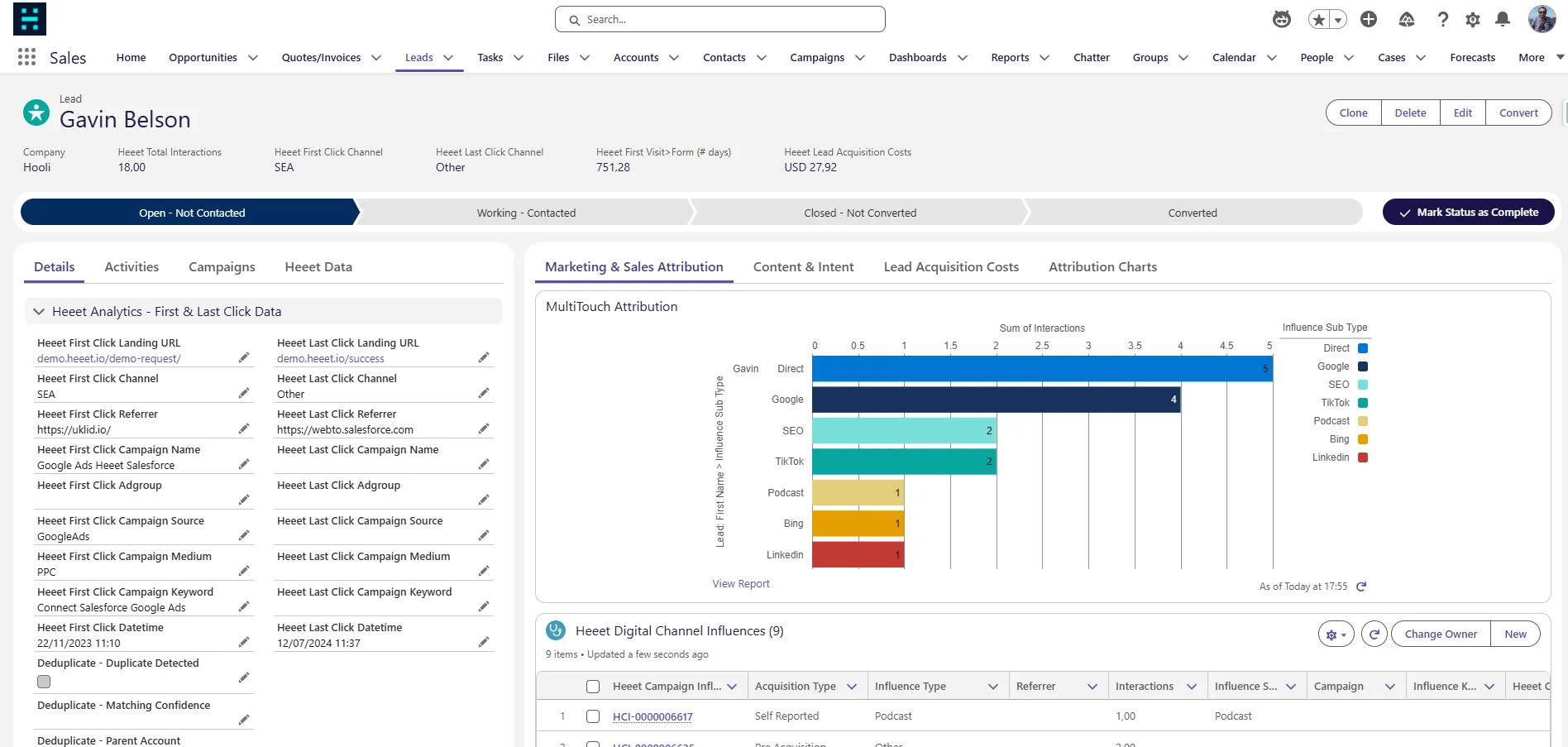
Heeet takes a CRM-first approach to paid ad attribution by writing marketing data directly onto native HubSpot or Salesforce objects instead of storing it in a separate reporting platform. That allows both sales and marketing teams to work from the same customer records without constantly switching between systems.
The platform supports attribution across multiple advertising channels while using cookieless, server-side tracking to improve data quality. For organizations already standardized on HubSpot or Salesforce, it offers a streamlined way to keep attribution inside the tools teams already use every day.
Key Features
- All-channel attribution stored on native CRM objects
- Cookieless server-side tracking across every ad platform
- Multi-touch models applied uniformly across channels
- Full pipeline and revenue attribution inside CRM reports
- Rapid deployment without dedicated developer resources
Pros
- No second dashboard to reconcile against your CRM
- Cookieless tracking holds up as channels tighten privacy
- CRM admins can build reports without vendor support
Cons
- Only useful for teams fully committed to HubSpot or Salesforce
- Premium pricing relative to non-native alternatives
- Cross-CRM or warehouse-native teams will find it limiting
Pricing
Plans start at approximately $1,490 per month based on third-party estimates.
G2 Rating
⭐ 4.8/5
Choosing the Right Paid Ad Attribution Tool
The best paid ad attribution tool depends on whether you need better reporting or a complete view of how your paid channels influence revenue. If LinkedIn, Google Ads, and Meta Ads are your primary acquisition channels, Fibbler brings them into one CRM view with transparent pricing and a setup that takes minutes, not months.
See how Fibbler’s cross-channel attribution works.
Written by

Adam Holmgren
CEO @ Fibbler

Prove paid ads drive pipeline
Fibbler helps you see which companies view or engage with your LinkedIn, Google and Meta Ads, and connect them to pipeline and revenue in your CRM.
Try 30 days for free
Prove paid ads drive pipeline
Fibbler helps you see which companies view or engage with your LinkedIn, Google and Meta Ads, and connect them to pipeline and revenue in your CRM.
Try 30 days for free